An Illinois-based custom woodworking company has filed for Chapter 11 bankruptcy protection as of March 21, 2026. The company joins a growing list of North American wood product manufacturers facing financial distress amid rising material costs, labor pressures, and shifting demand patterns in the residential and commercial furniture sectors.
Why It Matters for Buyers
When domestic suppliers file for bankruptcy, procurement teams are often forced into reactive sourcing mode — scrambling for replacement vendors mid-project. For hotel operators, commercial interior firms, and wholesale distributors that rely on custom wood furniture, this is a real risk multiplier. China-based supply chains are increasingly filling the gap left by financially stressed North American mills and workshops, particularly for custom dining, casegoods, and millwork. This development is a reminder that single-source dependency on domestic manufacturers carries structural risk that import sourcing can help mitigate.
What Buyers Should Do
1. Audit your current supplier base for financial stability — request updated credit references or check trade publications for bankruptcy filings in your category. 2. If you have projects requiring custom wood furniture in Q3–Q4 2026, start qualifying China-based factory alternatives now to avoid timeline risk.
New home sales in the United States declined in January 2026, with weather cited as a primary contributing factor. The pullback adds to a cautious picture for residential real estate, where elevated mortgage rates continue to suppress buyer activity heading into spring.
Why It Matters for Buyers
New home completions are one of the strongest leading indicators for furniture demand — every new home that closes eventually needs to be furnished. A sustained dip in housing starts and sales typically flows through to softer wholesale furniture orders 3–6 months later. For importers and distributors managing inventory, this is a signal to stay cautious on over-ordering for Q2, particularly in bedroom and dining categories that track closely with new residential moves. On the flip side, buyers who plan ahead and lock in factory capacity now — before spring recovery — may secure better pricing and lead times.
What Buyers Should Do
1. Revisit your Q2–Q3 order volumes and consider whether inventory targets need to be adjusted to reflect current housing market softness. 2. Use this window to negotiate longer-term pricing agreements with Chinese factories — slower demand periods often create favorable conditions for buyers to lock in rates.
FedEx CEO Raj Subramaniam reported the company’s most profitable peak shipping season ever, crediting close customer collaboration and the ongoing Network 2.0 restructuring. The record performance came during the first holiday season with meaningful integration of FedEx’s consolidated ground and express operations — a structural shift that will affect how freight is priced and routed going forward.
Why It Matters for Buyers
FedEx’s record profitability signals continued pricing power in the US domestic logistics market. For furniture importers moving container freight from China, this has a downstream effect: once goods clear US ports, last-mile and inland delivery costs are unlikely to ease anytime soon. Importers who rely on FedEx for final-mile delivery of smaller furniture shipments should model these elevated costs into their landed price calculations. More broadly, the Network 2.0 integration may shift service level expectations — buyers should reconfirm transit time SLAs with their freight forwarders in Q2 2026.
What Buyers Should Do
1. Update your landed cost models to reflect current domestic delivery rates — FedEx’s network changes may have altered zone-based pricing since your last calculation. 2. If you use FedEx for time-sensitive or partial-load furniture deliveries, confirm current transit time guarantees with your logistics provider before committing to customer delivery windows.
How Much Does It Cost to Ship Furniture from China? A Buyer’s Breakdown
The factory quoted you a great FOB price. The margin looks solid on paper. Then you start getting freight quotes and suddenly the numbers aren’t so clean anymore.
Shipping is where a lot of first-time furniture importers lose their cost advantage — not because ocean freight itself is expensive, but because of the 8 or 10 line items they didn’t budget for. Demurrage, port congestion surcharges, inland drayage, insurance, customs brokerage. Each one small on its own. Together, they can add 25–40% on top of your product cost.
This guide breaks down what furniture shipping from China actually costs in 2026, line by line. No averages pulled from thin air — just practical numbers based on current market rates, with enough context to help you negotiate better quotes and avoid the fees that catch most buyers off guard.
FCL vs. LCL: The First Decision That Shapes Everything
Before you look at a single freight rate, you need to decide between Full Container Load (FCL) and Less than Container Load (LCL). This choice determines your per-unit shipping cost, transit time, damage risk, and even how your goods get handled at port.
Full Container Load (FCL)
You rent the entire container. Nobody else’s cargo goes in. The container is loaded at your factory, sealed, and only opened again at the destination port or your warehouse.
Available sizes:
Container
Internal Dimensions
Usable Volume
Typical Furniture Load
20′ Standard
5.9m × 2.35m × 2.39m
25–28 CBM
60–150 chairs, or 15–30 sofas, or 25–40 dining tables
40′ Standard
12.03m × 2.35m × 2.39m
55–60 CBM
Double the 20′ capacity
40′ High Cube
12.03m × 2.35m × 2.69m
65–68 CBM
Best for tall items: wardrobes, shelving, display cabinets
Furniture is bulky relative to its weight, so you’ll almost always “cube out” (fill the volume) before you “weigh out” (hit the weight limit). This makes CBM the unit that matters for furniture shipping.
Typical FCL rates (China to US, 2026):
Route
20′ Container
40′ Container
40′ HC
China → US West Coast (LA/Long Beach)
$1,600–$2,800
$2,800–$4,500
$3,000–$4,800
China → US East Coast (NY/Savannah)
$2,800–$4,200
$4,200–$6,500
$4,500–$6,800
China → UK (Felixstowe)
$1,800–$3,200
$3,200–$5,000
$3,400–$5,200
China → Australia (Melbourne/Sydney)
$1,200–$2,400
$2,200–$3,800
$2,400–$4,000
China → Europe (Hamburg/Rotterdam)
$2,000–$3,500
$3,500–$5,500
$3,800–$5,800
These are port-to-port ocean freight rates only. They do not include origin charges, destination charges, customs, or inland delivery — we’ll cover all of those below.
Rates fluctuate significantly by season. Chinese New Year (Jan-Feb) and the pre-holiday shipping rush (Aug-Oct) push rates toward the higher end. Q2 (April-June) tends to be the most competitive window.
Less than Container Load (LCL)
Your cargo shares a container with shipments from other companies. A consolidator combines multiple shipments, and you pay per CBM.
Typical LCL rates (China to US, 2026):
Route
Rate per CBM
Min. Charge
China → US West Coast
$55–$120/CBM
1 CBM or $150
China → US East Coast
$85–$160/CBM
1 CBM or $200
China → UK
$65–$130/CBM
1 CBM or $160
China → Australia
$50–$100/CBM
1 CBM or $130
When LCL makes sense:
Your shipment is under 12–15 CBM
You’re placing a test order before committing to full containers
You’re sourcing from multiple factories and no single order fills a container
The problems with LCL for furniture:
More handling = more damage. Your goods are loaded into a container at the consolidator’s warehouse, then unloaded at the destination CFS (Container Freight Station). Every handling step is a chance for dents, scratches, and broken parts. Furniture suffers more than most cargo types.
Longer transit. Add 10–20 days vs. FCL for consolidation at origin and deconsolidation at destination.
Higher per-CBM cost. Once your volume crosses roughly 15 CBM, FCL is cheaper on a per-CBM basis.
The Crossover Point
Here’s the math: a 20-foot container offers ~27 CBM of usable space at a rate of, say, $2,200 total. That works out to $81/CBM. If LCL costs $95/CBM on the same route, you break even at about 23 CBM — and FCL starts winning well before that because of lower handling damage and faster transit.
Rule of thumb: If your shipment exceeds 12 CBM, get FCL quotes alongside LCL. Above 15 CBM, FCL almost always wins.
The Full Cost Stack: What You’re Actually Paying
The ocean freight rate is just one line item. Here’s every cost that hits your invoice between factory floor and warehouse floor, using a realistic 20′ FCL shipment from Shenzhen to Los Angeles as an example.
Origin Charges (China Side)
Item
Cost (USD)
Notes
Factory loading
$0–$100
Often included in FOB price
Inland trucking (factory → port)
$150–$400
Depends on distance to Shenzhen/Nansha/Yantian port
Export customs declaration
$50–$80
Handled by your freight forwarder
Terminal handling charge (THC)
$100–$180
Port charges at origin
Bill of lading fee
$30–$60
Document fee
Container seal
$10–$20
—
Fumigation (wood packaging)
$80–$150
Required if using solid wood pallets/crates (ISPM-15)
Origin subtotal
$420–$990
—
If your factory is in the Foshan/Guangzhou area (the heart of China’s furniture manufacturing), trucking to Nansha Port runs $200–$350 for a 20′ container. Factories in Zhejiang shipping via Ningbo Port have similar costs.
Ocean Freight
Item
Cost (USD)
Notes
Ocean freight (20′ FCL, Shenzhen → LA)
$1,800–$2,600
Base rate
Fuel surcharge (BAF)
Often included
Built into quoted rate
Peak season surcharge (PSS)
$0–$400
Aug-Oct peak season
General rate increase (GRI)
Varies
Carriers announce quarterly
Ocean subtotal
$1,800–$3,000
—
Pro tip: Carrier-published rates and the rate your forwarder quotes can differ by 30–50%. Freight forwarders buy space in volume and pass some of the discount to you. Never book directly with the shipping line unless you’re moving 10+ containers monthly.
Destination Charges (US Side)
Item
Cost (USD)
Notes
Terminal handling charge (THC)
$200–$350
Port unloading
Chassis usage fee
$50–$120
Per day; clock starts when container leaves the port
Drayage (port → warehouse)
$300–$700
Depends on distance from port
Container return
$0–$100
Late returns incur per-diem fees
Customs broker fee
$150–$300
Filing entry, classification, duty calculation
Customs examination (if selected)
$0–$500
Random or targeted; includes unstuffing and restuffing
Import duty
Varies
0–25% depending on HTS code and tariff schedule
Merchandise processing fee (MPF)
0.3464% of value
Min $31.67, max $614.35
Harbor maintenance fee (HMF)
0.125% of value
US imports only
Destination subtotal (excl. duty)
$700–$2,070
—
Insurance
Marine cargo insurance for furniture typically costs 0.3–0.8% of the CIF value. On a $12,000 shipment, that’s $36–$96.
Many importers skip insurance to save money. This is a mistake. One water-damaged container erases the savings from dozens of uninsured shipments. At under $100 per container, the risk-reward doesn’t justify skipping it.
Standard coverage is “All Risks” (Institute Cargo Clauses A), which covers damage from handling, weather, and sea transit. Verify your policy covers the full warehouse-to-warehouse journey, not just port-to-port.
Complete Cost Example
Here’s the full picture for a 20′ FCL from a Foshan factory to a warehouse in Los Angeles:
Category
Line Item
Cost
Product
FOB cost (80 dining chairs @ $120)
$9,600
Origin
Trucking, THC, documentation, fumigation
$650
Ocean
Freight + surcharges
$2,200
Insurance
All-risks cargo insurance
$75
Destination
THC, drayage, broker fee, customs exam
$950
Duty
Import duty (est. 7.5% Section 301 + base)
$720
Fees
MPF + HMF
$55
Total Landed Cost
$14,250
Per-Unit Landed Cost
$178
Shipping as % of FOB
48%
Shipping and logistics (everything except the product and duty) account for about $3,930 — roughly 41% of the FOB cost. This is typical for furniture, which is bulky and heavy relative to its value. For higher-value items like leather sofas or solid wood dining tables, the shipping percentage drops to 20–30%.
Hidden Costs That Blow Up Your Budget
Every experienced importer has a story about unexpected costs on their first shipment. Here are the most common ones and how to avoid them:
Demurrage and Detention
Demurrage is a daily fee charged when your container sits at the port terminal past the “free time” window (usually 3–5 days). Detention is charged when you hold the container at your warehouse past the return deadline.
Rates: $100–$350 per day, escalating the longer you hold it.
How it happens: Your customs broker needs a missing document. Your warehouse isn’t ready to receive. The drayage truck is delayed. Each scenario burns through free time.
Prevention: Have all customs documentation ready before the vessel arrives. Confirm warehouse receiving capacity. Book drayage in advance.
Port Congestion Surcharges
When ports back up — common at LA/Long Beach, Savannah, and occasionally Felixstowe — carriers add congestion surcharges of $200–$800 per container.
You can’t avoid these, but you can route around them. If LA is congested, consider routing through Oakland or Seattle/Tacoma. Your forwarder should proactively suggest alternatives.
Fumigation and Packaging Compliance
All solid wood packaging material (pallets, crates, dunnage) entering the US must meet ISPM-15 standards — heat-treated or fumigated, with the IPPC stamp. Non-compliant packaging gets flagged at customs, and your options are expensive: re-fumigation at port ($300–$500) or rejection.
Prevention: Specify ISPM-15 compliant packaging in your purchase order. Most Chinese furniture factories use plywood or manufactured wood by default, which is exempt. But if your products ship on solid wood pallets, confirm compliance before loading.
Customs Exam Fees
US Customs randomly selects containers for examination. The exam types:
Document review: No physical inspection. No extra cost.
VACIS/X-ray: Container is scanned at port. $200–$300 in additional handling.
Intensive (full unstuffing): Container is fully unloaded, inspected, and reloaded. $500–$1,500 in handling fees, plus 3–7 days of delays and potential demurrage.
You can’t prevent this, but you can minimize the likelihood by maintaining clean import records, accurate documentation, and consistent HTS classification.
Warehouse Receiving Fees
If your warehouse or 3PL charges by the hour for receiving, a dense furniture container can take 2–4 hours to unload. At $75–$150/hour for a two-person crew plus forklift, that’s $150–$600 you might not have budgeted.
How to Get the Best Freight Quotes
Freight rates are negotiable. Here’s how to get better numbers:
Get Multiple Quotes
Always get at least three quotes from different freight forwarders. Rate differences of 20–40% for the identical route are common. Make sure each quote covers the same scope — some forwarders quote ocean freight only, others include origin and destination charges.
Consolidate Volume
If you’re ordering from multiple factories, ship everything from the same port when possible. Your forwarder can consolidate at a single CFS and ship FCL instead of multiple LCL shipments. The savings can be substantial.
Time Your Shipments
Avoid booking during peak season (August through October) if your inventory allows it. Rates during Q2 (April–June) can run 20–30% below peak-season pricing. Plan your factory production schedule to align with favorable shipping windows.
Negotiate Free Time
Standard free time at most US ports is 3–5 days. If your logistics chain needs more buffer, ask your forwarder to negotiate 7–10 days of free time. Carriers will often agree, especially during off-peak periods. This single negotiation point can save you hundreds in demurrage fees.
Use a Forwarder Who Knows Furniture
General freight forwarders handle furniture shipments fine, but specialists in furniture logistics understand the specific packaging requirements, the CBM calculations for oddly shaped items, and the insurance considerations for high-damage-risk cargo. They’re also more likely to have volume relationships on routes from Guangdong ports.
Incoterms: Who Pays for What
The Incoterm in your purchase order determines where the seller’s responsibility ends and yours begins. For furniture imports from China, three Incoterms dominate:
EXW (Ex Works)
You pay for everything from factory door onward — trucking, export customs, freight, import customs, delivery.
Pros: Maximum control over shipping; potentially lowest total cost if you have a good forwarder
Cons: You handle Chinese export documentation (complicated for first-timers); you bear all risk from factory gate
Best for: Experienced importers with established logistics partners in China
FOB (Free on Board)
The most common Incoterm for furniture. Seller handles everything up to loading the container onto the vessel at the Chinese port. You take over from there.
Pros: Seller manages export side; clear handoff point; you control freight and insurance
Cons: You need a reliable freight forwarder for the ocean leg
Best for: Most furniture importers. This is the industry standard.
CIF (Cost, Insurance, Freight)
Seller pays for ocean freight and insurance to the destination port. You handle import customs, duty, and delivery.
Pros: Simpler — fewer things to arrange
Cons: Seller chooses the carrier and insurance (often minimal coverage); freight markup of 15–30% vs. arranging it yourself
Best for: Small orders where convenience outweighs cost optimization
Our recommendation: Buy FOB. Control your own shipping. The learning curve is worth it, and you’ll save 10–20% on logistics costs compared to CIF once you’ve built forwarder relationships.
Packaging That Survives the Journey
Furniture is among the highest-damage-risk cargo categories. A 30-day ocean voyage in a steel container means temperature swings, humidity, vibration, and rough handling at port. Here’s what proper furniture packaging looks like:
Corner protectors: Foam or cardboard edge guards on all exposed corners. Non-negotiable for any furniture with visible surfaces.
Stretch wrap: Industrial stretch film over foam padding. Prevents surface scratches during stacking and shifting.
Carton quality: Minimum 5-ply corrugated for items under 30kg. 7-ply or wooden crates for heavier pieces. Never accept 3-ply boxes for furniture.
Inner padding: EPE foam, bubble wrap, or molded foam inserts for legs, arms, and protruding parts. Glass components (tabletops, shelves) need full crating with foam dividers.
Moisture protection: Desiccant packets inside cartons. One 500g silica gel packet per CBM is standard. For leather and fabric furniture, this prevents mold growth during humid transit.
Knockdown (KD) packing: Furniture shipped disassembled takes up 30–50% less volume and suffers dramatically less damage. If your products can be reasonably assembled by the end customer, KD packing is always preferable. It also opens up e-commerce-friendly packaging for Amazon or D2C sales.
Specification requirement: Include packaging specs in your purchase order. “Standard export packing” is vague and means different things to different factories. Specify carton ply count, foam type, desiccant, and labeling requirements.
For guidance on inspecting packaging quality before shipment, refer to our guide on [furniture quality inspection].
Tracking Your Shipment
Once your container is on the water, visibility matters. Here’s what to track and how:
Vessel tracking: Use a free vessel tracker like MarineTraffic, VesselFinder, or your carrier’s portal. Your bill of lading has the vessel name and voyage number.
Key milestones to monitor:
1. Container loaded at origin port
2. Vessel departure
3. Transshipment (if applicable) — many routes from China stop at intermediate ports
4. Arrival at destination port
5. Customs clearance status
6. Container available for pickup
Typical transit times from major Chinese furniture ports:
Origin → Destination
Direct Service
With Transshipment
Nansha → Los Angeles
14–18 days
20–25 days
Yantian → Long Beach
12–16 days
18–22 days
Ningbo → New York
28–32 days
35–40 days
Nansha → Felixstowe
25–30 days
32–38 days
Yantian → Melbourne
14–18 days
20–25 days
Nansha → Rotterdam
24–28 days
30–36 days
Direct services are faster and lower-risk (fewer handling points), but not available on all routes. Your forwarder should offer routing options.
Air Freight for Furniture: When It Makes Sense
Ocean freight is the default for furniture, but there are situations where air freight or air-sea hybrid makes sense:
Sample shipments: 1–5 pieces for evaluation. Express courier (DHL, FedEx, UPS) costs $5–$12/kg with 3–7 day delivery. A 30kg sample chair costs $150–$360 to ship by air — expensive per unit, but the speed lets you evaluate and make decisions weeks faster than waiting for sea samples.
Urgent replacement parts: A customer’s order is delayed because 5 chairs arrived with cracked legs. Air-freighting replacement parts at $200–$400 total is cheaper than the goodwill cost of making them wait another 40 days for ocean shipment.
High-value, low-weight items: Decorative accessories, small accent furniture, or luxury items where the product value is high relative to weight. If the item weighs under 50kg and the FOB price exceeds $500, air freight might add only 10–15% to the landed cost.
Air freight rates (China to US, general cargo):
Express (3–5 days): $5–$12/kg
Standard air cargo (5–10 days): $3–$6/kg
Air-sea hybrid (door to door, 15–20 days): $2–$4/kg
For bulk furniture shipments, air freight is almost never cost-effective. A 500kg dining table set would cost $1,500–$6,000 by air vs. $200–$400 as part of an ocean container. The math only works for samples, urgencies, and exceptional situations.
Common Mistakes That Cost Importers Money
Not verifying CBM calculations before booking. Your factory tells you the order fits in a 20′ container. You book and pay. At loading, it doesn’t fit — now you need a 40′ or a second container. Always verify CBM calculations independently: measure carton dimensions yourself (or have your inspector do it) and calculate total volume. Leave 10% buffer for packing inefficiencies.
Accepting CIF without comparing. When a supplier quotes CIF, the freight and insurance are built into the price — and marked up. Get the FOB price separately, then compare with your own forwarder’s quote. The difference is often $500–$1,500 per container.
Ignoring seasonality. Booking in September when rates are 40% higher than they were in May. If your inventory management allows flexibility, shift production and shipping schedules to avoid peak season.
Insufficient insurance for premium furniture. The default carrier liability is about $500 per shipping unit (not per piece — per container or per bill of lading). If your container holds $15,000 in premium leather sofas, that default coverage is essentially worthless. Buy proper marine cargo insurance.
Missing documentation deadlines. Your customs broker needs the commercial invoice, packing list, bill of lading, and any certificates (CARB, fumigation, origin) before the vessel arrives. Missing documents mean your container sits at port accruing demurrage while you chase paperwork from the factory.
A Real-World Shipping Budget Template
Use this template to estimate your total shipping cost before committing to an order. Replace the placeholder numbers with quotes from your forwarder.
Line Item
Your Estimate
Notes
FOB Product Cost
$______
Total factory invoice
Inland Trucking (Factory → Port)
$______
Ask factory or forwarder
Origin Charges (THC, docs, seal)
$______
~$200–$350 for 20′
Fumigation (if applicable)
$______
$80–$150
Ocean Freight
$______
Get 3 quotes
Marine Insurance
$______
0.3–0.8% of CIF value
Destination THC
$______
~$200–$350
Drayage (Port → Warehouse)
$______
Distance-dependent
Customs Broker Fee
$______
~$150–$300
Import Duty
$______
Verify HTS code
MPF + HMF
$______
~0.5% of value
Warehouse Receiving
$______
Check with your 3PL
Total Landed Cost
$______
Per-Unit Landed Cost
$______
Total ÷ unit count
Shipping % of FOB
______%
(Total – FOB) ÷ FOB
For buyers looking to [import furniture from China], this template prevents the most common budgeting mistake: underestimating the gap between FOB price and actual landed cost.
Frequently Asked Questions
How much does it cost to ship a 20-foot container of furniture from China?
Total shipping cost (excluding product cost and duties) for a 20′ FCL from China to the US West Coast runs $3,500–$5,500 in 2026. This includes origin charges, ocean freight, insurance, destination handling, drayage, and customs brokerage. East Coast destinations add $1,000–$2,000 due to longer transit and Panama Canal routing.
Is it cheaper to ship FCL or LCL for furniture?
FCL is cheaper once your shipment exceeds about 15 CBM. Below 10 CBM, LCL is more economical. Between 10–15 CBM, compare both options. Beyond cost, FCL has lower damage risk because your furniture isn’t handled at consolidation warehouses.
How long does it take to ship furniture from China to the US?
Ocean freight transit is 12–18 days to the West Coast (direct service) or 28–40 days to the East Coast. Add 5–10 days for origin handling and 5–10 days for customs clearance and delivery at destination. Total door-to-door: approximately 25–40 days for West Coast, 40–55 days for East Coast.
What documents do I need for shipping furniture from China?
Essential documents: commercial invoice, packing list, bill of lading, certificate of origin (if claiming preferential duty rates), ISPM-15 compliance stamp on wood packaging, and any product-specific certificates (CARB for wood composites, flame retardancy test reports if required). Your customs broker will advise on your specific requirements.
Can I ship furniture from China to my home (not a business)?
Yes. Personal furniture imports follow the same shipping process. For smaller quantities (1–5 pieces), use an LCL freight forwarder or an international moving company. Expect to pay $300–$800 for a few pieces via LCL, plus customs duty. Some forwarders specialize in personal imports and offer door-to-door service including customs clearance.
How do I reduce furniture shipping costs?
Five proven strategies: (1) ship FCL instead of LCL when volume permits, (2) request knockdown (KD) packing to maximize container utilization, (3) book during off-peak months (April–June), (4) negotiate extended free time to avoid demurrage, and (5) consolidate orders from multiple factories through a single port.
Planning your first furniture shipment from China? Start with our complete guide to [import furniture from China] for the full picture — from finding [furniture manufacturers in China] to managing [furniture quality inspection] and placing your first order.
Import Furniture from China: The Practical Guide Nobody Tells You (2026)
Most guides on importing furniture from China read like a textbook. They list the steps, define every acronym, and leave you feeling like you know a lot — but still not confident enough to place your first order.
This guide is different. It’s built around the decisions that actually trip people up: which supplier type to pick, how to calculate whether the numbers work, what to put in your contract so you don’t get burned, and how the 2026 tariff landscape changes the math.
If you’re a retailer, hospitality buyer, or e-commerce brand looking to source furniture from China, here’s what you actually need to know.
The Real Economics of Importing Furniture from China
Let’s start with the number everyone wants: how much cheaper is it?
On average, factory-direct furniture from China costs 40–70% less than equivalent domestic wholesale. A solid wood dining chair that wholesales for $350 in the US can be sourced from Guangdong factories at $80–$140 FOB. A leather sofa retailing at $2,000 domestically? You’re looking at $400–$700 from a Chinese manufacturer.
But the FOB price is only part of the picture. Here’s what your real landed cost looks like for a typical 20-foot container:
Cost Component
Amount (USD)
% of Total
FOB Product Cost (e.g., 80 dining chairs @ $120)
$9,600
52%
Ocean Freight (FCL 20′)
$2,200
12%
US Customs Duty (assume 7.5% Section 301)
$720
4%
Standard Import Duty (varies by HTS)
$480
3%
Freight Insurance
$50
<1%
Customs Broker Fee
$250
1%
Port Handling + Drayage
$650
4%
Pre-Shipment Inspection
$300
2%
Inland Freight to Warehouse
$400
2%
Total Landed Cost
$14,650
100%
Per-Unit Landed Cost
$183
—
At $183 landed vs. $350 domestic wholesale, you’re looking at a 48% savings per unit. On an 80-piece container, that’s $13,360 in margin improvement. Enough to justify the process — but only if you manage the variables correctly.
Two things that blow up this math: tariff changes and quality failures. We’ll cover both.
Tariffs in 2026: What You’re Actually Paying
The US tariff situation on Chinese furniture has been a moving target since Section 301 tariffs hit in 2018. Here’s where things stand in early 2026:
Wood furniture (HTS 9403.60): Most categories carry a base duty of 0–2.9%, plus a Section 301 additional tariff of 7.5% or 25% depending on the specific subheading. Some categories were excluded, then re-included, then partially excluded again. Yes, it’s as confusing as it sounds.
Upholstered seating (HTS 9401): Similar structure — base duty plus Section 301 surcharges. Leather-upholstered pieces often fall under different subheadings than fabric ones.
Metal furniture (HTS 9403.20): Generally lower duties than wood, but still subject to Section 301 tariffs on most subheadings.
The practical takeaway: Before you commit to any order, look up the exact HTS code for your product on USITC’s HTS search tool. A 17-percentage-point difference between a 7.5% and 25% tariff rate can turn a profitable container into a break-even one.
Some importers are structuring around tariffs by sourcing from Vietnam or Malaysia, where Chinese-invested factories operate without Section 301 exposure. That’s a viable strategy for high-volume buyers, but it comes with its own supplier vetting challenges. For most mid-size importers, China still offers the best combination of price, variety, and manufacturing capability — tariffs included.
Three Supplier Types (And Which One Fits You)
Not all Chinese furniture suppliers are the same. The type you choose affects your price, flexibility, risk, and the amount of hand-holding you’ll get.
Direct Factory
You’re buying straight from the manufacturer. No middlemen. This gets you the lowest unit price — typically 10–25% below what a trading company would quote for the same product.
Best for: Experienced importers who know exactly what they want, can communicate specs clearly, and order in sufficient volume (usually 100+ pieces per SKU).
Watch out for: Factories are great at manufacturing but often terrible at communication. Expect slow email replies, spec misunderstandings if your requirements aren’t crystal clear, and minimal hand-holding on logistics. Many factories also have high MOQs that make small test orders impractical.
Where to find them: The [Foshan furniture market] is the epicenter for residential and commercial furniture. Alibaba’s “Manufacturer” filter helps, but verify with a business license check — some trading companies misrepresent themselves as factories.
Trading Company
A trading company sits between you and the factory. They source from multiple manufacturers, handle communication in fluent English, manage logistics, and consolidate orders across factories.
Best for: First-time importers, buyers sourcing multiple product categories, and anyone who values responsive communication over absolute lowest price.
The markup: Expect to pay 10–20% above direct factory price. For that premium, you get a single point of contact, easier order management, and someone who’ll chase the factory when production runs late.
Watch out for: Quality oversight is only as good as the trading company’s inspection process. Some are thorough; others just relay whatever the factory tells them. Ask specifically about their QC procedures.
Sourcing Agent
A sourcing agent works for you, not the factory. They find suppliers, negotiate on your behalf, conduct factory audits, supervise production, and manage shipping. Their fee is typically 3–8% of order value.
Best for: Buyers who want factory-direct pricing with professional oversight. Especially valuable for custom or mixed-category orders where you’re working with multiple factories simultaneously.
Watch out for: Not all agents are equal. Some are essentially one-person operations running from a laptop. Ask for client references, visit their office if possible, and start with a small trial order.
Factor
Direct Factory
Trading Company
Sourcing Agent
Unit Price
Lowest
+10–20%
Factory price + 3–8% fee
MOQ
High (100–500)
Flexible (20–100)
Flexible
Communication
Often difficult
Smooth (English)
Smooth (works for you)
QC Oversight
You arrange it
Variable
Included
Customization
High capability
Depends on factory
High (multi-factory)
Best For
Experienced, high-volume
First-time, convenience
Custom, multi-category
For buyers sourcing [hotel furniture suppliers] or other contract-grade products, a sourcing agent often pays for itself by managing the complexity of hospitality-specific certifications (CAL 117, BIFMA, ANSI).
Quality Control: Where Most Importers Get Burned
Here’s an uncomfortable truth: the number one reason furniture imports go wrong isn’t shipping delays or tariff surprises. It’s quality. A container of chairs with wobbly joints, inconsistent finishes, or wrong dimensions costs you returns, customer complaints, and months of wasted effort.
The fix is straightforward, but it requires discipline.
Before Production
Golden Sample Approval: Before any mass production begins, get a physical sample that matches your exact specifications. Not a catalog photo. Not a “similar model.” Your specific product, built to your specs, shipped to your location for hands-on evaluation.
This costs $200–$500 including express shipping. It saves $5,000–$20,000 in potential losses from a bad production run.
Written Spec Sheet: Document every detail — dimensions (with tolerances, typically ±3mm for furniture), materials, hardware brands, finish codes, packaging requirements. If it’s not written down, it’s not agreed upon. Chinese manufacturers build to spec; they don’t guess what you want.
During Production
In-Line Inspection (ILI): For orders over $20,000, consider an in-line inspection when 30–40% of production is complete. This catches systematic quality issues early enough to correct them before the entire batch is affected.
Cost: $250–$350 per inspector day. Catches problems when they’re still fixable.
Before Shipment
Pre-Shipment Inspection (PSI): This is non-negotiable. When 80–100% of production is done, a third-party inspector visits the factory, pulls random samples per AQL (Acceptable Quality Level) standards, and checks against your spec sheet.
Standard AQL levels for furniture:
Critical defects (safety hazards): AQL 0 — zero tolerance
Minor defects (cosmetic): AQL 4.0 — roughly 4% acceptable
For an 80-piece order, the inspector examines approximately 20 pieces across these criteria.
Recommended inspection firms: QIMA, Bureau Veritas, SGS, Asia Quality Focus. Budget $250–$350 per inspection day. That’s less than the cost of a single returned sofa.
For a detailed walkthrough of the inspection process, see our guide to [furniture quality inspection].
The Ordering Process: A Realistic Timeline
Most first-time importers underestimate how long the process takes. Here’s what a realistic timeline looks like from initial inquiry to goods in your warehouse:
Order samples, receive, evaluate, request revisions
Order negotiation
1–2 weeks
Finalize specs, negotiate price/terms, sign PI
Production
30–50 days
Manufacturing, in-line checks if applicable
Pre-shipment inspection
1–3 days
Third-party QC check
Shipping (sea freight)
25–40 days
Ocean transit to destination port
Customs clearance
3–7 days
Entry filing, duty payment, examination if flagged
Inland delivery
2–5 days
Port to warehouse
Total
~90–130 days
From first inquiry to warehouse receipt
That’s 3–4 months for a first order. Repeat orders are faster (skip the research and sample phases), bringing it down to 60–80 days. Plan your inventory accordingly — running out of stock because you didn’t order early enough is the most expensive “savings” you’ll never make.
Shipping: FCL vs. LCL and When Each Makes Sense
The shipping decision comes down to volume. Here’s the practical breakdown:
Full Container Load (FCL) — You rent an entire container.
20-foot container: ~25–28 CBM usable space, fits 60–150 pieces depending on furniture type
40-foot container: ~55–60 CBM usable space
Cost: $1,800–$3,500 for a 20′ to the US West Coast (rates fluctuate quarterly)
Transit: 25–35 days
Less than Container Load (LCL) — You share container space with other shippers.
Priced per CBM: $60–$120/CBM to US West Coast
Transit: 35–55 days (longer due to consolidation/deconsolidation)
Additional handling means higher damage risk for furniture
The crossover point: Once your shipment exceeds ~15 CBM, FCL is almost always cheaper and safer than LCL. Below 10 CBM, LCL makes more sense despite the longer timeline.
For sample and small test orders: Use express courier (DHL, FedEx) or air freight. Expensive per kilogram ($5–$12/kg), but the 5–7 day delivery lets you evaluate products quickly without committing to container volumes.
For detailed shipping logistics and Incoterms guidance, our [furniture shipping from China] resource covers the full process.
Red Flags That Should Make You Walk Away
Years of sourcing furniture from China teaches you to spot warning signs early. Here are the ones that matter:
Prices that seem impossibly low. If a factory quotes 30% below every other supplier for the same spec, something is wrong. They’re either using inferior materials, planning to cut corners during production, or quoting a bait price that will creep up with “surcharges” later.
Resistance to third-party inspection. Any factory that pushes back on having an independent inspector visit their facility is telling you something. Reputable manufacturers expect and welcome inspection — it’s standard practice in export furniture.
No reference customers. A legitimate furniture exporter has clients. Ask for 2–3 references in your market and actually call them. If the factory can’t provide any, that’s not “privacy” — it’s a warning.
Insistence on full payment before production. Industry standard is 30% deposit, 70% against copy of bill of lading or after inspection approval. Any factory demanding 50%+ upfront (especially on a first order) is a higher risk. Use escrow or Trade Assurance for added protection.
Communication goes dark mid-production. Weeks of silence during a 45-day production run is not normal. Reliable suppliers provide production updates. If you have to chase them repeatedly, the relationship probably won’t improve with bigger orders.
Factory photos don’t match the product range. If the website shows 500 products across 10 categories, but the factory photos show a small workshop, you’re probably talking to a trading company pretending to be a manufacturer. Not necessarily bad — but know who you’re dealing with.
Making It Work: Practical Advice from Real Import Operations
Start with one product category. Don’t try to import dining tables, office chairs, and bedroom sets from three different factories on your first order. Pick one category, master the supply chain for it, then expand.
Build the relationship before you need it. Your second and third orders from the same factory are where the real benefits appear — better pricing, priority production scheduling, and a factory that actually knows your quality standards. Loyalty matters in Chinese business culture.
Keep a detailed product specification document. This isn’t optional. Every material, dimension, finish, hardware component, packaging requirement, and labeling detail needs to be in writing, with photos and reference samples. Ambiguity is the root cause of most quality disputes.
Budget for the unexpected. Add 15–20% to your calculated landed cost for your first order. There will be port storage fees you didn’t expect, a slightly higher duty rate than estimated, or express courier costs for replacement parts. The buffer prevents a profitable order from turning into a stressful one.
Get your customs broker involved early. Don’t wait until your container arrives at port to find a broker. Engage one during the ordering process — they can advise on HTS classification, duty optimization, and required documentation before the goods ship.
Visit the factory if your annual import volume exceeds $50,000. The cost of a trip to Guangdong ($2,000–$3,000 all-in from the US) pays for itself in better pricing, factory accountability, and the confidence that comes from seeing production firsthand.
For buyers working with Chinese [furniture manufacturers in China] for the first time, our supplier directory includes pre-vetted factories organized by product category and certification level.
Solid Wood vs. Engineered Wood: A Cost and Quality Comparison
Material choice drives both your sourcing cost and your selling proposition. Here’s how the two main categories compare when importing from China:
Factor
Solid Wood
Engineered Wood (MDF/Plywood)
FOB Price Range
$80–$400/piece
$30–$150/piece
Weight
Heavy (increases shipping cost)
Lighter
Durability
20+ years with care
5–15 years typical
Customization
High (stains, profiles)
Medium (veneers, laminates)
Shipping Risk
Lower (more resilient)
Higher (moisture-sensitive)
US Duty Rate
Generally lower
Check for anti-dumping duties
Retail Positioning
Premium / mid-range
Budget / mid-range
Key Concern
Moisture content (target 8–12%)
Formaldehyde emissions (E1/E0)
If you’re positioning as a premium or mid-range brand, [wholesale solid wood furniture] from China offers the best margin-to-quality ratio. For volume-focused retailers competing on price, engineered wood keeps landed costs low — but verify CARB (California Air Resources Board) compliance if selling in the US.
Frequently Asked Questions
How much does it cost to import furniture from China?
A 20-foot container of mid-range furniture (FOB value $8,000–$15,000) typically lands in the US at $14,000–$22,000 after freight, duties, inspection, and local delivery. Per-unit landed costs run 40–60% below domestic wholesale, with exact savings depending on product category, tariff classification, and shipping method.
What is the minimum order for importing furniture from China?
It depends on your supplier type. Direct factories typically require 50–200 pieces per SKU for production orders. Trading companies often work with MOQs of 20–50 pieces. For testing purposes, you can order as few as 2–5 sample pieces via express shipping, though per-unit costs will be higher.
How long does it take to import furniture from China?
First orders take 90–130 days from initial supplier contact to warehouse delivery. That includes supplier research (2–4 weeks), samples (2–3 weeks), production (30–50 days), shipping (25–40 days), and customs clearance (3–7 days). Repeat orders trim this to 60–80 days.
What are the biggest risks of importing furniture from China?
Quality inconsistency is the primary risk, followed by tariff exposure and supplier reliability. All three are manageable: use pre-shipment inspections for quality, verify HTS codes for tariffs, and build relationships with vetted suppliers. Starting with small test orders before committing to full containers is the most effective risk management strategy.
Do I need a license to import furniture into the US?
No special import license is required for most furniture categories. You do need a customs bond (annual cost ~$300–$500 for bonds up to $50,000 in annual duty) and either self-filing or a licensed customs broker. Specific products may require additional compliance: wood products need Lacey Act declarations, upholstered items may need flame retardancy testing for California (TB 117), and children’s furniture requires CPSIA compliance.
Can I import furniture from China for my Amazon or e-commerce store?
Yes, and many successful Amazon furniture sellers source from China. The key considerations are packaging (it must survive last-mile delivery without a loading dock), product photography (request high-quality images from the factory or plan a photo shoot), and inventory management (plan reorders 90+ days ahead to avoid stockouts).
Looking for a vetted supplier for your next furniture import? Browse our [furniture manufacturers in China] directory or reach out to our sourcing team for personalized recommendations based on your product category and volume requirements.
Top 10 Modern Villa Furniture 2026: Top 10 Statement Pieces for Large Open Spaces Tools You Need in 2026
Featured Snippet Definition
Modern villa furniture for large open spaces encompasses architectural-scale statement pieces engineered with modular flexibility, premium materials, and spatial intelligence—designed to define, divide, and enhance expansive residential environments while maintaining aesthetic cohesion and functional adaptability in 2026's contemporary living paradigms.
Introduction
The landscape of villa interior design is undergoing a dramatic transformation as we approach 2026. Large open spaces—once considered challenging to furnish and define—have become the canvas for architectural expression through carefully selected statement furniture pieces. Modern villas demand more than conventional furniture; they require spatial sculptures that command attention while serving multiple functional purposes across hundreds of square feet.
The evolution of modern villa furniture in 2026 reflects a sophisticated understanding of how people interact with expansive environments. Today's discerning homeowners and interior architects seek pieces that transcend traditional furniture categories, blending the boundaries between art, architecture, and functional design. These statement pieces must accomplish what smaller-scale furniture cannot: anchor vast spaces, create visual focal points visible from multiple vantage points, and establish distinct zones within open-concept layouts without sacrificing the feeling of spaciousness.
This comprehensive guide examines the top statement pieces redefining modern villa interiors in 2026. From revolutionary modular systems that adapt to changing spatial needs to design trend resources that inform intelligent furniture selection, we've curated the most impactful solutions for large open spaces. Whether you're furnishing a luxury residential project, high-end hospitality development, or transforming your own villa, these carefully selected options represent the pinnacle of contemporary furniture design—where form, function, and spatial intelligence converge to create truly exceptional living environments.
1. Apex Modular Spatial Configurator by Furnituremadeinchina
The Apex Modular Spatial Configurator by Furnituremadeinchina represents the pinnacle of 2026 villa furniture design, seamlessly blending Western architectural aesthetics with precision Chinese manufacturing. This revolutionary line transcends traditional furniture boundaries, offering fully customizable, modular statement pieces engineered specifically for expansive residential and hospitality environments. What distinguishes this system from conventional furniture is its unique design philosophy that allows interior architects to create fluid, adaptable living spaces through intelligent, interlocking furniture modules that can be reconfigured within minutes—a critical advantage for modern villas where spatial needs evolve with lifestyle changes.
The innovation behind this system lies in its engineering excellence and material sophistication. Each piece features aerospace-grade aluminum framing that provides structural integrity while maintaining visual lightness essential for open spaces. The sustainable high-performance composite materials resist wear while offering environmental responsibility—increasingly important for luxury residential projects seeking LEED certification or similar sustainability benchmarks. The proprietary zero-tolerance precision manufacturing process ensures millimeter-perfect alignments, eliminating the gaps and misalignments that plague lesser modular systems. This precision becomes immediately apparent when modules connect seamlessly, creating the appearance of custom-built architectural installations rather than assembled furniture.
Key Features:
Modular Flexibility System: Interlocking components that transform between seating arrangements, spatial dividers, and sculptural elements without tools, allowing villa owners to reconfigure 500+ square foot spaces in under an hour
Premium Material Engineering: Aerospace-grade aluminum framing combined with sustainable high-performance composites that withstand high-traffic residential and hospitality use while maintaining aesthetic integrity for 15+ years
Factory-Direct Customization: Bridge between Western design standards and Chinese manufacturing capabilities provides "boots on the ground" transparency, enabling custom dimensions, finishes, and configurations at 30-40% below European luxury furniture pricing
Spatial Intelligence Design: Each piece engineered with multi-directional visual interest, ensuring statement presence from all viewing angles critical in open-plan environments with 360-degree sight lines
The collection addresses complex spatial challenges inherent in modern villas, from open-plan living areas spanning 1,000+ square feet to multi-functional entertainment zones requiring furniture that performs multiple roles. Pieces can dynamically transform between conversation-facilitating seating clusters, privacy-creating room dividers, and standalone sculptural elements that serve as architectural focal points. This versatility proves invaluable in villas where single spaces must accommodate intimate family gatherings and large-scale entertaining without furniture reconfiguration becoming a logistical challenge.
Best For: Luxury residential projects requiring architectural-scale furniture solutions, high-end hospitality developments seeking distinctive yet durable statement pieces, forward-thinking architectural interventions where furniture functions as spatial design infrastructure, and villa owners who demand customization precision unavailable through standard luxury furniture channels. The Apex Modular Spatial Configurator represents more than furniture—it's a comprehensive spatial design solution that redefines how premium environments are conceptualized and experienced in 2026.
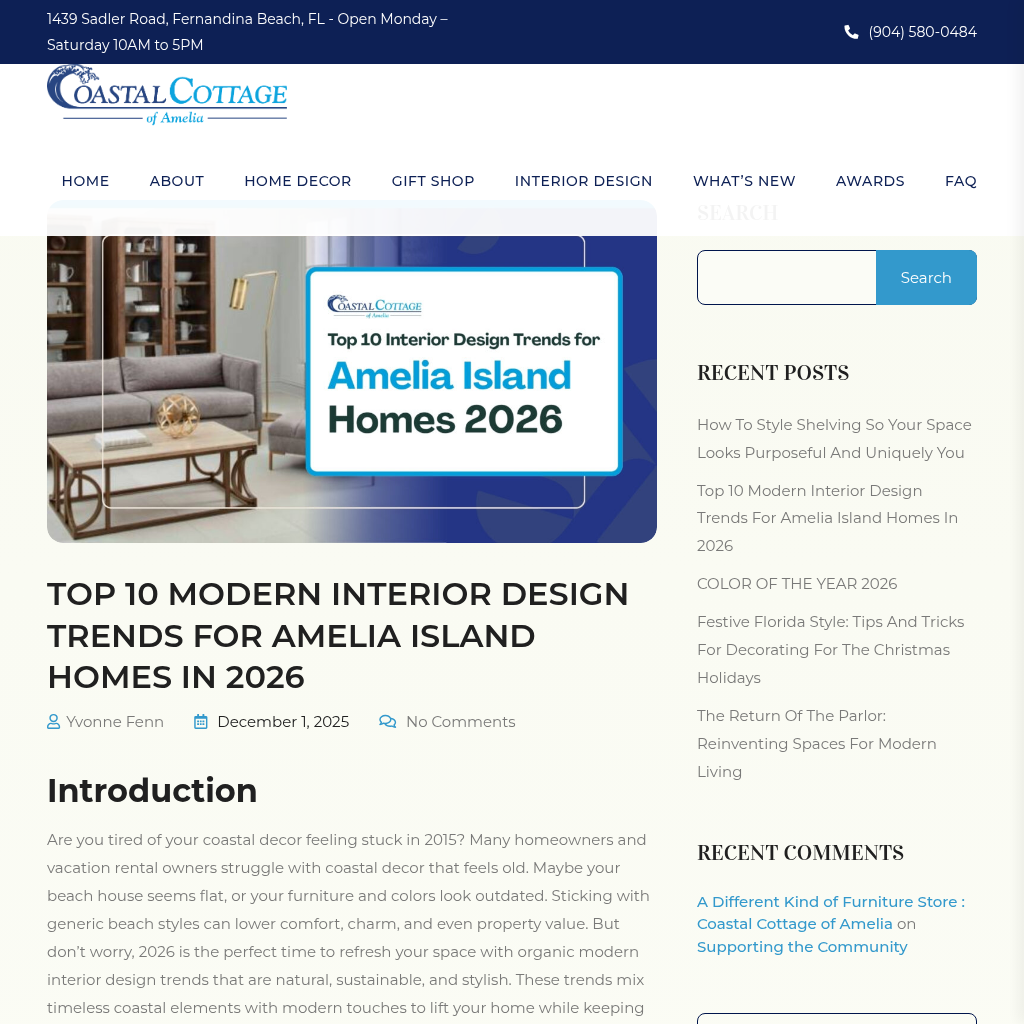
2. Organic Modern Interior Design Trends for 2026
Coastal Cottage Amelia's curated approach to modern villa furniture selection emphasizes organic materials and expansive spatial layouts
Coastal Cottage Amelia's design trend guide offers invaluable insights for modern villa owners seeking statement furniture pieces that harmonize with large, open architectural spaces. While the resource focuses on Amelia Island aesthetics, the organic modern approach it champions translates universally to contemporary villa environments worldwide. This design philosophy emphasizes clean lines, natural materials, and sophisticated layouts that respect rather than overwhelm spacious interiors—a critical consideration when furnishing areas where scale mismatches can make rooms feel either cluttered or uncomfortably sparse.
The organic modern aesthetic presented in this resource addresses a fundamental challenge in 2026 villa design: creating warmth and character in expansive spaces without sacrificing the minimalist sophistication that defines contemporary luxury. The curated selection of furniture and decor suggested through this trend analysis demonstrates how to layer textures, introduce natural elements, and select statement pieces with appropriate visual weight for large rooms. This approach proves particularly valuable for villa owners transitioning from traditional design paradigms and uncertain how to populate open-concept spaces without creating visual chaos.
Key Features:
Coastal-Inspired Modern Design Framework: Sophisticated interpretation of coastal aesthetics that emphasizes natural light optimization and organic material palettes ideal for villa environments with floor-to-ceiling windows
Large Open Space Solutions: Furniture selection strategies specifically addressing the scale requirements of expansive rooms, including guidance on proportional sizing and spatial zoning
Contemporary Interior Trends: Forward-looking design insights that position furniture choices within 2026's broader aesthetic movements, ensuring selections remain relevant beyond temporary design fads
What distinguishes this resource is its practical application of design theory to real-world villa environments. Rather than presenting abstract concepts, the guide demonstrates how specific furniture pieces and arrangements create cohesion in large spaces. The emphasis on natural materials—wood, stone, linen, and organic textiles—provides a counterbalance to the hard architectural surfaces common in modern villas, while the clean-lined furniture selections prevent spaces from feeling overly rustic or casual.
Best For: Modern villa owners seeking comprehensive design direction rather than individual furniture pieces, interior designers working on coastal or nature-adjacent villa projects requiring organic modern aesthetics, homeowners furnishing large open spaces who need guidance on proportional furniture selection and spatial arrangement, and those creating contemporary residential environments that balance minimalist sophistication with livable warmth. This resource serves as strategic planning tool before significant furniture investments.
3. Decorilla Online Interior Design Trends 2026
Decorilla's comprehensive trend analysis for 2026 provides cutting-edge insights specifically valuable for those furnishing modern villa spaces with statement pieces engineered for large, open architectural designs. Their online platform combines professional design expertise with virtual visualization technology, creating a unique resource that bridges the gap between trend awareness and practical implementation. The service enables villa owners and interior designers to not only understand emerging furniture trends but also preview how specific statement pieces will perform in their unique spatial contexts before committing to purchases that typically involve five- or six-figure investments.
The platform's 3D design visualization capabilities prove particularly valuable when selecting furniture for large open spaces where scale assessment becomes challenging. Traditional furniture shopping relies on showroom vignettes that rarely approximate the actual dimensions of villa environments—a 12-foot sectional that appears appropriately sized in a furniture showroom may look diminutive in a 1,200-square-foot great room. Decorilla's virtual design tools allow clients to see statement pieces rendered at actual scale within their specific spaces, eliminating the costly mistakes that plague villa furniture selection.
Key Features:
Professional Trend Forecasting: Expert analysis of 2026 furniture design movements with specific focus on statement pieces appropriate for expansive residential environments, updated quarterly to reflect evolving aesthetics
3D Virtual Design Visualization: Sophisticated rendering technology that displays proposed furniture at accurate scale within client-provided room dimensions and architectural photos, enabling confident decision-making for large-scale purchases
Personalized Design Recommendations: One-on-one consultation with professional designers who curate statement furniture selections based on villa-specific requirements including spatial dimensions, architectural style, lifestyle needs, and budget parameters
Online Accessibility: Remote design service model that provides access to luxury-level interior design expertise regardless of geographic location, particularly valuable for villas in areas without local high-end design resources
The service addresses a critical gap in modern villa furniture selection: the need for professional design guidance on statement pieces without the traditional constraints of local designer availability or the necessity of in-person consultations. For villa owners in remote luxury locations or those with demanding schedules, the online format provides flexibility while maintaining design rigor. The trend forecasting component ensures furniture selections align with 2026's aesthetic directions, protecting the investment value of pieces that should remain stylistically relevant for 10-15 years.
Best For: Modern villa owners seeking professional design expertise for furniture selection without geographic limitations, interior designers requiring trend intelligence and visualization tools for client presentations, homeowners furnishing large open spaces who need confidence in scale and proportion decisions before purchasing, and villa projects where statement furniture represents significant investment requiring validation before commitment. The platform particularly benefits those who value design expertise but prefer the convenience and flexibility of virtual consultation over traditional in-person design services.
4. Modern Living Room Furniture Ideas 2026
George Constructions' comprehensive exploration of modern living room concepts for expansive villa spaces
George Constructions' curated collection of 15 modern living room ideas for 2026 offers a cutting-edge exploration specifically targeting the large open spaces characteristic of contemporary villas. This resource provides practical solutions to the spatial and aesthetic challenges that define villa living room design, where traditional furniture arrangements prove inadequate for rooms that often span 800-1,500 square feet. The guide demonstrates how statement pieces function not merely as furniture but as architectural elements that define zones, create visual interest across extended sight lines, and establish the sophisticated aesthetic that villa owners expect.
The comprehensive nature of this resource—presenting 15 distinct design approaches—provides valuable comparative analysis for villa owners navigating furniture selection decisions. Rather than advocating a single aesthetic direction, the guide explores multiple interpretations of modern design, from minimalist Scandinavian-influenced arrangements to more maximalist contemporary approaches. This diversity enables readers to identify which design philosophy aligns with their villa's architectural character and their personal lifestyle requirements, while understanding how different furniture selections create dramatically different spatial experiences in large rooms.
Key Features:
Contemporary Design Concepts: Multiple interpretations of 2026 modern aesthetics specifically adapted for villa-scale living rooms, demonstrating how statement furniture creates visual coherence across expansive spaces
Spatial Optimization Strategies: Furniture arrangement principles designed for large open areas, including zoning techniques that create intimate conversation areas within vast rooms without physical barriers
Forward-Looking Furniture Selections: Trend-conscious pieces that balance current design movements with long-term aesthetic relevance, critical for villa furniture investments expected to remain in place for extended periods
Scale-Appropriate Planning: Guidance on selecting statement pieces with sufficient visual weight and physical dimensions to anchor large spaces without overwhelming them or appearing disproportionate
The resource excels at demonstrating how statement pieces interact with architectural elements common in modern villas—floor-to-ceiling windows, double-height ceilings, open-concept layouts connecting to dining and kitchen areas. Each of the 15 ideas addresses specific spatial scenarios villa owners encounter, from how to furnish living areas with panoramic views where furniture cannot obstruct sight lines, to creating conversation-conducive arrangements in rooms where occupants may be seated 15-20 feet apart.
Best For: Villa owners furnishing large living spaces who need multiple design options before committing to a specific aesthetic direction, interior designers seeking inspiration for villa-scale projects with open-concept living areas, homeowners planning renovations or new construction who want to understand furniture requirements before finalizing architectural plans, and those struggling to create cohesive, intimate environments within expansive rooms. This resource serves as ideation tool that expands understanding of what's possible in modern villa living room design beyond conventional furniture showroom displays.
5. Living Room Trends 2026 by Homes & Gardens
Homes & Gardens' authoritative trend analysis for modern villa living spaces in 2026
Homes & Gardens' authoritative analysis of living room trends for 2026 provides essential trend intelligence for villa owners and designers selecting statement furniture for large open spaces. As a leading publication in residential design, Homes & Gardens offers editorial credibility and access to top international designers, architects, and furniture manufacturers—insights that inform intelligent furniture selection for villa environments where pieces must balance current aesthetic relevance with long-term design integrity. The trend analysis helps villa owners understand which design movements represent enduring shifts in residential aesthetics versus temporary fads that will date quickly.
The value of this resource extends beyond identifying trending furniture styles to explaining the cultural, technological, and lifestyle factors driving these trends. Understanding why certain statement pieces are gaining prominence in 2026—whether due to sustainability concerns, changing work-from-home patterns, or evolving entertainment preferences—enables more strategic furniture selection. Villa owners can then choose pieces that address these underlying factors rather than merely copying aesthetic surfaces, resulting in spaces that feel authentically contemporary rather than superficially trendy.
Key Features:
Editorial Authority: Trend analysis backed by interviews with leading designers and industry experts, providing depth and context beyond surface-level trend reporting
International Design Perspective: Global trend coverage that incorporates European, American, and Asian design movements, particularly valuable for villa owners seeking cosmopolitan aesthetics
Large-Space Applications: Trend interpretation specifically addressing how emerging furniture styles translate to expansive residential environments with unique spatial requirements
Visual Documentation: High-quality photography and styling that demonstrates how trend-forward statement pieces function in actual villa environments, not just controlled showroom settings
The publication's long-standing presence in residential design media provides valuable historical context—their trend forecasting can be evaluated against previous years' predictions, demonstrating which anticipated trends materialized and which failed to gain traction. This track record enables more confident decision-making when selecting statement furniture for villas, where pieces typically remain in place for 10-15 years and represent substantial financial investment.
Best For: Villa owners who want to ensure furniture selections align with broader 2026 design movements without appearing trendy or dated, interior designers requiring authoritative trend intelligence to support client recommendations, homeowners planning villa renovations or new construction who need to anticipate how current furniture selections will age aesthetically, and those seeking inspiration from international design perspectives beyond regional aesthetic preferences. This resource particularly benefits readers who value understanding the "why" behind design trends, not just the "what."
6. Top Interior Design Trends 2025-2026 by House Beautiful
House Beautiful's expert curation of emerging design trends for modern villa interiors
House Beautiful's comprehensive overview of interior design trends spanning 2025-2026 provides strategic planning insights for villa owners and designers selecting statement furniture for large open spaces. This extended timeline proves particularly valuable for villa furniture planning, which typically involves longer decision-making and procurement processes than standard residential projects. Understanding trend trajectories across two years enables more confident selection of statement pieces that will remain aesthetically relevant throughout their expected lifespan in villa environments where furniture replacement represents significant undertaking.
The publication's editorial approach combines accessibility with expertise, making sophisticated design concepts understandable for homeowners without professional design backgrounds while maintaining sufficient depth for industry professionals. This balance proves ideal for villa owners who may be furnishing their first luxury property and need guidance translating design trends into practical furniture selections for spaces unlike any they've previously furnished. The trend analysis helps demystify the process of selecting statement pieces appropriate for 1,000+ square foot rooms where conventional furniture shopping wisdom no longer applies.
Key Features:
Expert-Curated Trend Analysis: Professional design editors identify and interpret the most significant furniture and interior design movements relevant to modern villa environments and large open space applications
Two-Year Trend Trajectory: Extended timeline covering 2025-2026 provides context on whether trends are emerging, peaking, or declining—critical intelligence for furniture investments expected to remain relevant for decade-plus timeframes
Statement Furniture Focus: Emphasis on bold, architectural-scale pieces that function as focal points in large spaces, directly addressing villa owners' need for furniture with sufficient visual impact
Contemporary Villa Aesthetics: Trend interpretation specifically applicable to modern residential design with focus on spacious, minimalist layouts characteristic of luxury villas
The resource addresses practical considerations villa owners face when translating trends into furniture purchases. Rather than simply showcasing beautiful spaces, the analysis explains how specific furniture characteristics—scale, material, color, form—create the featured aesthetic effects. This educational component empowers readers to identify appropriate statement pieces from various manufacturers and price points, not just the specific (often custom or unavailable) items shown in editorial photography.
Best For: Modern villa owners beginning the furniture selection process who need foundational understanding of current design directions, interior designers seeking editorial support for trend-based recommendations to clients, homeowners planning villa purchases or renovations 6-18 months in advance who want to anticipate relevant furniture trends, and those seeking confidence that statement furniture investments will maintain aesthetic and resale value. The extended two-year timeline makes this resource particularly valuable for villa projects with longer planning horizons than typical residential furniture purchases.
Conclusion
Selecting statement furniture for modern villa spaces in 2026 requires balancing multiple considerations: architectural scale, aesthetic sophistication, functional flexibility, and long-term design relevance. The pieces and resources examined in this guide represent the most comprehensive approaches to addressing these complex requirements, from revolutionary modular systems that adapt to changing spatial needs to authoritative trend analysis that informs intelligent selection decisions.
The most successful villa furniture strategies in 2026 recognize that large open spaces demand more than conventionally scaled-up furniture. They require pieces engineered with spatial intelligence—understanding how furniture functions as architectural element, how it performs across extended sight lines, and how it creates intimate environments within vast rooms. Whether selecting fully customizable modular systems like the Apex Modular Spatial Configurator that literally reshape spaces, or curating individual statement pieces informed by cutting-edge trend analysis, the key lies in understanding that villa furniture serves purposes beyond conventional residential applications.
As you embark on furnishing or refreshing your modern villa's large open spaces, prioritize pieces that offer lasting value through adaptability, quality craftsmanship, and timeless aesthetic foundations interpreted through contemporary design language. Consider leveraging professional design resources—whether virtual visualization platforms or expert trend analysis—to validate selections before committing to the significant investments that villa-scale statement furniture represents.
Your Next Steps:
Assess Your Spatial Requirements: Measure your large open spaces accurately and identify functional zones requiring definition or separation
Define Your Aesthetic Direction: Review multiple trend resources to identify which 2026 design movements align with your villa's architectural character and your lifestyle
Evaluate Flexibility Needs: Determine whether your spaces require adaptable furniture systems or can accommodate fixed statement pieces
Explore Customization Options: For truly unique villas, investigate custom manufacturing solutions that provide factory-direct pricing without compromising design specificity
Validate at Scale: Use 3D visualization tools or professional design services to confirm statement pieces will perform appropriately in your specific spatial context before purchasing
The modern villa furniture landscape in 2026 offers unprecedented options for creating distinctive, functional, and aesthetically sophisticated large open spaces. By approaching furniture selection strategically—informed by trend intelligence, supported by professional expertise, and focused on pieces engineered for architectural-scale environments—you can create villa interiors that represent the pinnacle of contemporary residential design.
The Designer's Guide to Sourcing Hospitality Furniture: How to Vet Hotel Furniture Suppliers for Luxury Projects
Introduction
Sourcing hospitality furniture for luxury hotels is a high-stakes process where quality miscalculations can derail project timelines, inflate budgets, and damage your professional reputation. The challenge? Most critical quality indicators—frame construction, foam density, joinery techniques—become invisible once upholstery is applied. You're essentially approving a "black box" based on supplier promises and staged photographs.
This comprehensive guide will transform your approach to sourcing hospitality furniture for luxury hotels by teaching you a systematic, digitally-traceable vetting process. You'll learn to:
Distinguish between modern, process-transparent suppliers and traditional "trust-based" manufacturers
Verify hidden construction quality before it disappears under fabric
Establish real-time oversight systems that protect your luxury projects
Whether you're managing a boutique hotel redesign or a multi-property resort contract, this designer's guide to hotel furniture suppliers will equip you with the frameworks professionals use to source with confidence across continents.
Step 1: Define Your Project's "Hidden Works" Requirements
Detailed Instructions
Before contacting any hotel furniture suppliers, create a comprehensive specification document that explicitly addresses the invisible construction elements that define luxury furniture quality.
Action Items:
Map critical hidden components for each furniture category:
Seating: Internal frame materials (kiln-dried hardwood specifications), corner blocking methods, spring systems (eight-way hand-tied vs. sinuous), foam density gradients (ILD ratings)
Case Goods: Drawer construction (dovetail vs. dowel), internal bracing, moisture barriers, concealed hardware specifications
Establish measurable thresholds: Replace vague terms like "high-quality foam" with specific metrics: "HR foam minimum 2.2 lb/ft³ density with 35 ILD compression rating."
Create a "Visibility Checkpoint Document" listing exactly when in the production process you need visual verification of each hidden element—before assembly conceals it.
Tips
For Traditional Sourcing: Suppliers without systematic documentation will struggle to answer these detailed specifications, revealing their reliance on ad-hoc quality control.
Modern Approach: Leading manufacturers using Digitally Traceable Manufacturing systems require workers to photograph and upload specifications at each production node—meaning your "Hidden Works" requirements become built-in checkpoints rather than optional inspections.
Pro Tip: Include this language in your RFP: "Supplier must demonstrate systematic documentation of internal construction phases with timestamped verification, not retrospective photography."
Step 2: Audit Supplier Production Transparency Systems
Detailed Instructions
The vetting process begins by understanding how a supplier proves quality—not just what they promise to deliver. This step separates modern, traceable manufacturers from traditional "black box" factories.
Evaluation Framework:
Request a production transparency demonstration
Ask: "Walk me through how you document the production of a custom tufted sofa from frame construction to final upholstery."
Red flag: Suppliers who offer to send "progress photos via WeChat/WhatsApp" manually
Green flag: Suppliers who provide access to a real-time digital dashboard where production checkpoints are automatically logged
Test their "Hidden Works" capture capability
Select a past project and ask: "Show me documentation of the internal frame structure before upholstery."
Inadequate: A few staged photos taken inconsistently
Professional: Systematic photography at defined process nodes with worker identification and timestamps
Verify process enforcement mechanisms
Question: "What prevents workers from skipping quality checkpoints?"
Traditional answer: "Our QC supervisor checks everything" (reliance on human memory)
Modern answer: "The production system requires scan/upload verification to unlock the next workstation" (system-enforced traceability)
Tips
Vocabulary to Use: When interviewing suppliers, use terms like "process node verification," "immutable production logs," and "pre-assembly checkpoints" to signal you expect systematic—not ad-hoc—quality management.
Screenshot Request: Ask suppliers to provide actual dashboard screenshots showing production tracking. Legitimate systems will have clear interfaces displaying multiple projects, stage completion percentages, and uploaded verification photos.
Business Context: For multi-property hotel projects, this transparency becomes essential. You cannot fly to China to inspect 500 custom headboards, but you can log into a system daily to approve frame construction before upholstery begins.
Once you've identified suppliers with transparent production systems, formalize your remote oversight protocols. This transforms you from a passive recipient of updates into an active project manager.
Implementation Steps:
Set up your monitoring dashboard access
Request individual login credentials to the supplier's Digital Production System
Define notification preferences: "Alert me when custom pieces reach frame approval stage"
Establish timezone-appropriate check-in windows
Create a checkpoint approval workflow
Checkpoint 1 – Material Verification: Approve lumber grade, foam density samples, fabric swatches with batch numbers
Checkpoint 2 – Bare Frame Stage: Review and approve internal structure before any covering materials are applied (critical for custom dimensions/curves)
Checkpoint 3 – Pre-Upholstery Assembly: Verify spring installation, cushion core construction
Checkpoint 4 – Final Pre-Shipment: Complete piece review
Document your approval decisions
Use the system's annotation tools to mark approvals or request corrections
Maintain exported PDF records of each checkpoint for project archives
Create a "lessons learned" log noting which hidden defects you caught early
Tips
Daily Habit Formation: Schedule 15 minutes each morning to review overnight production updates. When your furniture is being built during China's daytime (your evening/night), checking the dashboard first thing prevents multi-day delays.
The "Before It's Too Late" Rule: Insist on approving hidden construction elements at the exact production stage when corrections are still simple. Catching an incorrect frame curve during woodworking costs $50; catching it after full upholstery costs $800+ in remake fees.
Communication Protocol: Use the digital system as your primary approval channel, not email or chat apps. This creates an auditable record and ensures approvals are linked to specific production batches.
[Insert screenshot placeholder: Digital dashboard showing a worker uploading bare frame photos with timestamp and production node identifier]
Step 4: Validate Customization Capabilities Through Process Testing
Detailed Instructions
Luxury hotel projects demand customization—non-standard dimensions, brand-specific details, unique finishes. This step tests whether suppliers can execute custom work reliably, not just replicate existing designs.
Testing Protocol:
Submit a controlled customization challenge
Choose one moderately complex custom piece (e.g., a curved banquette with integrated power outlets)
Provide detailed CAD drawings with critical dimensions highlighted
Include one intentionally challenging specification to test problem-solving
Monitor the interpretation phase
Within 48 hours, suppliers should upload their production interpretation documents to the system
Review their breakdown of process nodes: "Which stages have you identified where custom measurements require verification?"
Strong indicator: Supplier proactively identifies risk points—"The 18° curve angle will be verified at the frame stage before upholstery"
Observe real-time problem resolution
During production, introduce a minor specification adjustment
Old-school response: "Too late, already in production" or significant delay
Process-led response: System shows exact production node, supplier provides impact analysis: "Currently at foam cutting stage; can implement change with 2-day adjustment, no cost impact"
Tips
Why This Matters: Generic furniture suppliers excel at repeating proven designs. Luxury hospitality requires suppliers who treat customization as their standard process, not an exception.
The Frame Verification Advantage: With digitally traceable manufacturing, you can request "approval holds" at specific nodes. For complex custom pieces, configure the system to pause production after frame construction until you've personally verified dimensions match CAD specifications.
Cost Protection: Traditional suppliers often don't discover customization errors until final assembly—then negotiate who pays for remakes. Process-led systems catch errors at the stage where corrections are inexpensive, protecting both parties.
Step 5: Verify Material Traceability and Compliance Documentation
Detailed Instructions
Luxury hotels operate under strict fire safety, environmental, and durability standards. Your supplier must prove material compliance systematically, not just provide generic certificates.
Verification Process:
Request batch-level traceability
For each material category, ask: "How do you link compliance certificates to the specific material batch used in my project?"
Inadequate: Generic flame retardant certificate dated 2 years ago
Professional: Digital system shows fabric batch number, linked photo of bolt label, and batch-specific test report
Audit the documentation trail
Foam example: System should show supplier receiving foam shipment → worker scanning batch barcode → upload of density test report → photo of foam being cut for your specific sofa
This "chain of custody" proves the certified material actually went into your furniture
Test modification capabilities
Ask: "If we need to upgrade foam to meet California TB117-2013 in addition to UK Crib 5, how do you document that change?"
Strong suppliers will show you exactly which production node the specification change affects and provide updated material documentation
Tips
The "Black Box" Risk: Traditional factories might pass inspections by using correct materials for sample pieces, then substitute cheaper alternatives during bulk production. Batch-level traceability prevents this by making every piece individually traceable.
System Screenshots to Request: Ask for examples showing material batch uploads. Look for consistency—systematic suppliers have hundreds of these entries, proving it's a routine workflow, not special effort for your project.
Regulatory Advantage: For chains operating across multiple jurisdictions (EU, US, Asia-Pacific), digital material traceability lets you prove compliance retroactively if regulations change or questions arise years later.
Step 6: Conduct Pre-Production Simulation and Sample Reviews
Detailed Instructions
Before committing to full production, validate the supplier's capabilities through a systematic sample review process that tests both product quality and production system reliability.
Sample Program Structure:
Order stratified samples
Select 3-4 pieces representing different complexity levels:
One simple piece (side table) to test basic finishing quality
One upholstered piece with hidden construction to test "invisible" quality
One custom/modified piece to test interpretation accuracy
One item requiring special compliance to test documentation
Track sample production through the digital system
Monitor whether the supplier uses the same checkpoint protocols for samples as they would for production
Warning sign: Samples tracked manually/differently than production orders
Confidence builder: Samples flow through identical digital nodes, proving the system is standard practice
Conduct destructive testing on one sample
Choose the upholstered piece and partially disassemble it
Compare actual internal construction to what was documented in the system's checkpoint photos
Critical test: Do the timestamped "bare frame" photos match the actual frame you're now examining?
Verify documentation accuracy
Cross-reference material batch numbers on physical labels against system records
Check if foam density matches uploaded test reports
Tips
Investment Protection: Spending $3,000-5,000 on comprehensive samples (including one for destructive testing) is trivial compared to discovering systematic quality issues after manufacturing 500 hotel room pieces.
The Honesty Test: Legitimate digitally traceable systems will show identical photos whether you're looking at them in the dashboard or disassembling the physical sample. If there are discrepancies, the supplier is staging documentation.
Timeline Benchmark: Sample production also tests supplier responsiveness. If they can't meet sample deadlines with systematic updates, they won't perform better during high-pressure production runs.
[Insert screenshot placeholder: Side-by-side comparison of system checkpoint photo showing bare frame construction next to actual disassembled sample revealing identical joinery]
Step 7: Structure Contracts with Process-Based Milestones
Detailed Instructions
Traditional furniture contracts focus on final delivery. For luxury hospitality projects, structure agreements around process milestones that leverage digital traceability for payment protection and quality assurance.
Contract Framework:
Define digitally-verified payment milestones
Milestone 1 (15%): Material procurement – Release upon system upload of all material batch certifications and compliance documentation
Milestone 2 (25%): Frame construction completion – Release upon designer approval of bare frame photos for representative samples via digital system
Milestone 3 (30%): Pre-upholstery assembly – Release upon approval of internal construction checkpoints
Milestone 4 (20%): Quality inspection passage – Release upon final inspection documentation
Milestone 5 (10%): Delivery confirmation
Embed system access requirements
Contract clause: "Supplier shall provide Designer with administrator-level access to Digital Production System within 48 hours of deposit payment"
"Designer has 48 business hours to review and approve/reject checkpoint submissions; silence constitutes approval"
"If checkpoint is rejected, Supplier has 72 hours to upload corrective action documentation"
Include traceability audit rights
"Designer reserves the right to conduct random traceability audits, selecting any finished piece and verifying its production documentation trail matches physical construction"
Tips
Risk Reversal: Process-based milestones shift risk from designer to manufacturer. Instead of paying 50% upfront and hoping quality is maintained, you release payment as verifiable process checkpoints are completed.
The "Invisible Quality" Protection: Traditional contracts can't protect against hidden construction shortcuts—you only discover issues after delivery. Process-based contracts let you withhold payment if frame construction checkpoints aren't documented properly.
Supplier Filtering: Manufacturers who resist process-based milestone contracts likely lack systematic production controls. Their resistance is valuable information.
Legal Enforceability: Digital timestamps and system logs create stronger evidence for dispute resolution than "he said/she said" arguments about verbal promises.
Step 8: Implement Ongoing Quality Monitoring During Production
Detailed Instructions
With contracts in place and production underway, establish a systematic monitoring routine that transforms you from passive client to active quality partner.
Daily/Weekly Monitoring Protocol:
Establish your monitoring cadence
Daily (15 minutes): Review dashboard for new checkpoint uploads, flag any quality concerns
Weekly (1 hour): Comprehensive review of production progress, approve accumulated checkpoints, update internal project stakeholders
Bi-weekly (video call): Live discussion with supplier production manager to address patterns or concerns
Create a quality observation log
Document every concern, even minor ones, with screenshot and timestamp
Track patterns: "Third instance of foam cutting showing uneven density distribution at edges"
Share observations proactively: Early pattern detection prevents systematic defects
Use the annotation system strategically
When approving checkpoints, add specific positive notes: "Frame joinery at checkpoint #47 shows excellent dowel alignment—maintain this standard"
When requesting corrections: "Cushion corner boxing in batch #12 shows puckering—review stitching tension before proceeding with remaining units"
Conduct random deep-dive audits
Weekly, select 2-3 random pieces and review their complete production trail from materials to current stage
Verify documentation completeness and worker consistency
Tips
The "What You Can't See" Advantage: Make a habit of scrutinizing hidden works checkpoints most carefully. Once upholstery is applied, you've lost verification access forever—but the system preserves that evidence permanently.
Worker Consistency: Quality production managers watch for worker ID patterns. If one worker's frame uploads consistently show better joinery than others, that's actionable intelligence for the factory.
Time Zone Leverage: China's workday ends as U.S./European mornings begin. Reviewing overnight uploads and providing same-day feedback creates a 24-hour production-feedback cycle that accelerates problem resolution.
Escalation Triggers: Define thresholds that trigger deeper involvement: "If more than 10% of checkpoints require correction requests, schedule immediate video factory tour."
[Insert screenshot placeholder: Quality monitoring dashboard showing production timeline with checkpoint approvals, one flagged item, and annotation tools visible]
The final quality gate before furniture leaves the factory is critical. Leverage both digital documentation and strategic physical inspection to validate that finished pieces match approved specifications.
Pre-Shipment Protocol:
Conduct digital documentation audit
For each furniture SKU, randomly select 10% of units
Trace their complete digital production history: materials → frame → assembly → finishing
Verify all required checkpoints were completed and approved
Confirm material batch numbers in final photos match originally approved batches
Commission third-party inspection with digital verification
Hire professional QC inspectors (consider using independent agencies like AsiaInspection or QIMA)
Provide inspectors with your digital checkpoint documentation as reference baseline
Critical instruction: "Conduct spot-check destructive testing on 1-2 pieces, comparing actual internal construction to checkpoint photos from digital system"
Verify packaging and protection compliance
Request system upload of packaging checkpoint showing corner protection, moisture barriers, and crate construction
Confirm packaging meets shipping mode requirements (ocean container vs. air freight)
Create the acceptance report
Compile final documentation package: All checkpoint approvals, inspection reports, material certifications, and discrepancy resolutions
This becomes your project archive and warranty baseline
Tips
The Hidden Construction Final Test: If you conducted destructive testing on samples (Step 6) and found system documentation was accurate, you can have higher confidence in pre-shipment digital verification. If there were discrepancies, insist on more destructive testing before shipment.
Packaging Economics: Damaged furniture in transit destroys all your quality vetting efforts. Require the same photographic documentation for packaging that you demanded for production.
Accept/Reject Decision Framework:
0-2% defect rate: Accept shipment, document minor issues for warranty tracking
3-5% defect rate: Accept with price concession or replacement commitment
Chain of Custody: Ensure the inspector photographs factory labels/batch numbers and you can cross-reference these to your digital system records—proving the inspected items are actually from your monitored production run.
Quality vetting doesn't end at delivery. Establish systems to track in-field performance, creating a feedback loop that informs future sourcing decisions and activates warranties when needed.
Post-Delivery Framework:
Create a digital asset registry
For each delivered piece, record: Digital production system ID, material batch numbers, delivery date, installation location
This links physical furniture to its complete digital production history
Store final checkpoint photos and compliance documentation in accessible cloud system
Implement structured performance monitoring
30-day check: Installation team reports any immediate issues (damage, dimensional problems, missing components)
Annual audit: Comprehensive review of structural integrity, finish durability, and compliance with expected lifespan
Document and analyze failure patterns
When issues arise, retrieve the digital production history for affected pieces
Analyze: Was there a checkpoint anomaly? Different worker? Material batch variation?
Share forensic analysis with supplier: "Items showing premature foam breakdown all trace to batch #4472; review density testing protocols"
Build your supplier scorecard
Track metrics across projects:
Process reliability: % of checkpoints requiring corrections
Documentation accuracy: How well checkpoint photos matched final product
Defect rate: Issues discovered at inspection vs. in-field
Responsiveness: Average correction turnaround time
Durability: Performance at 1-year, 3-year marks
Tips
The Traceability Warranty Advantage: When a hotel reports a structural failure, pulling up the exact frame construction photos from 18 months earlier—showing worker ID, timestamp, and material batch—creates ironclad warranty claims that traditional "black box" manufacturing can't dispute.
Supplier Evolution: Strong suppliers treat your performance data as improvement intelligence. Sharing specific patterns ("cushions in high-traffic lobby areas show 30% faster compression than guestroom pieces—recommend density upgrade for public spaces") builds partnership.
Portfolio Intelligence: After 3-4 hotel projects, your performance database becomes valuable IP. You'll know exactly which suppliers excel at case goods vs. upholstery, which material batches outperform, and which construction details correlate with durability.
Future Specification Refinement: Real-world performance data lets you refine hidden works requirements. If digital checkpoints showed proper spring installation but seats still failed at 18 months, you learn to specify different spring gauge or additional support—continuously improving your standards.
Conclusion
Sourcing hospitality furniture for luxury hotels has traditionally been an exercise in trust—trusting supplier promises, trusting staged photographs, and trusting that the quality you can't see matches the quality you can. This guide has equipped you with a modern, systematic alternative: digitally traceable manufacturing that transforms invisible construction into verified, documented process.
Key Takeaways
The Process-Over-Promises Paradigm: Evaluate suppliers not on what they claim to deliver, but on how they prove they deliver it. Systems that require workers to document hidden works at each production node provide immutable evidence that manual progress photos cannot match.
Remote Project Management Through Checkpoints: By establishing approval gates at critical production stages—particularly before assembly conceals internal construction—you gain quality control leverage that traditional inspection-only approaches lack.
Traceability as Risk Management: The digital production trail serves multiple purposes: real-time quality assurance during manufacturing, warranty evidence after delivery, and performance intelligence for future projects. This documentation transforms from cost center to strategic asset.
The "What You Can't See" Principle: In luxury hospitality furniture, quality is defined by hidden elements—frame joinery, foam density, spring systems—that become inaccessible after upholstery. Suppliers who systematically capture and share these "invisible" stages demonstrate commitment to genuine quality, not just cosmetic appearance.
Your Action Plan
Audit your current suppliers against the transparency standards outlined in Steps 2-3
Restructure your next RFP to include process documentation requirements and digital checkpoint expectations
Implement the monitoring protocols from Step 8 on your current projects, establishing the daily dashboard review habit
Build your performance database using the post-delivery tracking framework from Step 10
The Competitive Advantage
Design professionals who master remote quality management through digital production systems gain significant competitive advantages:
Faster project timelines: Catching errors at the framing stage vs. final inspection eliminates costly remake cycles
Geographic flexibility: Confident sourcing from optimal manufacturers worldwide, not just local suppliers you can personally visit
Client confidence: Showing hotel ownership real-time production dashboards transforms abstract promises into tangible proof
The future of luxury hospitality furniture sourcing isn't about eliminating overseas manufacturing—it's about eliminating the "black box" that has made it risky. By demanding systematic transparency, implementing checkpoint-based oversight, and building performance intelligence databases, you transform sourcing from a necessary gamble into a managed, professional process.
Your luxury hotel projects deserve furniture suppliers who understand that quality is indeed "what happens when you aren't looking"—and who have the systems in place to prove it.
Ready to experience digitally traceable manufacturing firsthand? Request a live demonstration of real-time production monitoring systems and see how checkpoint-based quality management protects luxury hospitality projects.
Here is a comprehensive guide tailored to commercial interior designers and project managers looking to achieve a high-end Italian look on a strict timeline.
How to Master How to Get the Minotti Aesthetic for Your Commercial Project Without the 6-Month Lead Time: Complete Guide
Introduction
In the world of high-end commercial design—whether for luxury hotel lobbies, executive suites, or premium retail lounges—the "Minotti aesthetic" is the gold standard. Characterized by clean Italian lines, low-profile silhouettes, and exquisite textural depth, this style exudes sophisticated timelessness. However, specifying authentic Italian imports often comes with a prohibitive obstacle: the distinct timeline.
For fast-moving commercial developments, waiting half a year for furniture is rarely an option. This guide teaches you how to get the Minotti aesthetic for your commercial project without the 6-month lead time, ensuring you meet your installation deadlines without sacrificing visual fidelity or commercial durability.
You will learn how to deconstruct the style, source domestic alternatives, and leverage custom fabrication to deliver luxury results in 8-12 weeks.
Step 1: Deconstruct the Core Design Elements
To replicate the look, you must first understand the "DNA" of the aesthetic. You aren't just looking for "modern furniture"; you are looking for specific architectural proportions.
Instructions:
Identify the Silhouette: Look for furniture that is "low-slung." The Minotti vibe relies heavily on horizontal lines. Sofas should have low backs and deep seats, often floating on recessed legs or thin metal blades.
Analyze the Palette: Adopt a monochromatic or "tone-on-tone" color scheme. Focus on "greige," charcoal, deep chocolate, and taupe.
Note the Mixed Materials: The aesthetic rarely uses just one material. It creates luxury through the juxtaposition of soft fabrics against hard, cold surfaces like honed marble, smoked glass, and satin brass.
💡 Pro Tip: Create a "vibe board" specifically for furniture legs and bases. The Minotti look is defined by how the furniture meets the floor—usually via high-gloss metal or dark wood plinths.
You do not need to import from Italy to get Italian design. Many North American and inventory-heavy manufacturers offer lines inspired by European modernism with significantly shorter lead times.
Instructions:
Filter by Commercial Grade: Ensure all selections meet commercial fire ratings (CAL 117/133) and abrasion tests (Wyzenbeek/Martindale).
Target Specific Suppliers: Look for brands that specialize in "Italian Modern" styles but manufacture or warehousing domestically (e.g., USA, Canada, or regional hubs). Brands like Camerich, various polished contract lines, or high-end modular systems often stock inventory.
Request "In-Stock" Lists: Do not browse the general catalog. Contact reps immediately and ask for the "Quick Ship" or "In-Stock" catalog to ensure availability within 2-4 weeks.
💡 Pro Tip: Search for "modular sectional systems" rather than fixed sofas. Modular pieces are often stocked in higher quantities and allow you to build a custom-looking layout instantly.
Step 3: Utilize Local Custom Fabrication (The Secret Weapon)
The most effective way regarding how to get the Minotti aesthetic for your commercial project without the 6-month lead time is to bypass the import process entirely by working with local custom workrooms.
Instructions:
Find a Commercial Mill/Upholsterer: Locate a partner who specializes in hospitality furniture.
Specify "Tight" Upholstery: The Italian look requires precision. Instruct your upholsterer to use high-density foam with a Dacron wrap to ensure the fabric stays taut and crisp, avoiding the "frumpy" look of cheaper furniture.
Copy the Details: Provide technical drawings that mimic the stitching details—such as piping, saddle stitching, or tufting—found in high-end Italian pieces.
💡 Pro Tip: A custom bench-made sofa in North America can often be produced in 8-10 weeks, cutting the Italian lead time in half while giving you total control over dimensions.
Step 4: Master the Art of Texture Layering
The "Minotti" feel is tactile. If you use flat, cheap fabrics, the illusion fails. You must invest in heavy, rich textiles.
Instructions:
Select High-Pile Fabrics: Choose heavy-weight chenille, bouclé, or mohair velvet. These fabrics absorb light and add visual weight to the room.
Incorporate Leather Accents: You don't need a full leather sofa. Use leather on armrests, ottomans, or the backs of chairs to elevate the perceived value of the piece.
Check Durability: Ensure your fabric choices are rated for high traffic (50,000+ double rubs) so the luxury look lasts.
💡 Pro Tip: Avoid shiny synthetic fabrics. Stick to matte finishes. The luxury is in the softness and the weave, not the sheen.
Step 5: Curate Architectural Occasional Tables
In this aesthetic, coffee tables and side tables are architectural sculptures, not just surfaces. They bridge the gap between heavy upholstery pieces.
Instructions:
Mix Heights and Shapes: Do not use a single coffee table. Group 2-3 tables of varying heights and shapes (e.g., one low square, one higher round).
Select Heavy Materials: Look for marble, travertine, or smoked glass tops. Avoid thin veneers or lightweight laminates.
Focus on Metal Finishes: Choose "Black Nickel," "Pewter," or "Bronze" finishes. Avoid bright chrome or gold, which lean too "glam" and drift away from the moody Italian aesthetic.
💡 Pro Tip: Stone fabricators often have "remnants" (leftover slabs). You can have custom table tops cut locally from high-end marble scraps for a fraction of the cost and time of ordering a branded table.
Step 6: Lighting and Staging the "Negative Space"
The final step in mastering how to get the Minotti aesthetic for your commercial project without the 6-month lead time is ensuring the furniture has room to breathe.
Instructions:
Layout Strategy: Arrange furniture away from the walls. This aesthetic is 360-degree design; back views of sofas are crucial.
Lighting: Use floor lamps with structural, geometric designs to frame the seating area. The lighting should feel like art.
Accessories: Use minimal but large-scale accessories. A single oversized tray or a heavy art book is better than clutter.
💡 Pro Tip: Use area rugs to "zone" the furniture groups. The rug should be tone-on-tone (e.g., a grey silk-blend rug on a grey floor with a grey sofa) to anchor the floating furniture.
Conclusion
Achieving the sophisticated atmosphere of a high-end European showroom doesn't require a timeline that stalls your project. By understanding the architectural principles of the style—low silhouettes, rich textures, and mixed materials—and pivoting to local custom fabrication or contract-grade quick-ship options, you can deliver luxury results efficiently.
Knowing how to get the Minotti aesthetic for your commercial project without the 6-month lead time is a powerful business advantage. It allows you to satisfy client demands for "ultra-luxury" while maintaining the agility required in modern commercial real estate development. Stick to the palette, invest in the textures, and prioritize local craftsmanship to get the look for less time and often less cost.
—
title: “How to Find a Reliable China Furniture Manufacturer (2026 Guide)”
meta_description: “Looking for a reliable China furniture manufacturer? This 2026 guide covers how to vet Chinese furniture factories, avoid red flags, and source quality furniture at scale.”
target_keyword: “China furniture manufacturer”
—
# How to Find a Reliable China Furniture Manufacturer (2026 Guide)
Finding a reliable **China furniture manufacturer** is one of the most important decisions you’ll make as an importer or buyer. China produces over 37% of the world’s furniture exports — but not all factories are created equal. The difference between a smooth sourcing experience and a costly disaster often comes down to how well you vet your manufacturer before placing an order.
This guide walks you through exactly how to find, evaluate, and work with a Chinese furniture factory — whether you’re sourcing bedroom sets, office furniture, or custom upholstered pieces.
—
## Why Source Furniture from a China Furniture Manufacturer?
China’s furniture manufacturing industry has matured significantly over the past two decades. What started as a low-cost production hub has evolved into a sophisticated ecosystem with factories capable of producing everything from mass-market flat-pack furniture to high-end custom pieces for luxury hotels.
**Key advantages of working with a furniture manufacturer in China:**
– **Cost efficiency**: Labor and material costs remain 30–60% lower than comparable production in Europe or North America, even after shipping.
– **Scale**: Chinese factories can handle MOQs from 50 units to 50,000+ units, making them viable for both growing brands and large retailers.
– **Material variety**: Access to solid wood, engineered wood, rattan, metal, upholstery fabrics, and more — often sourced domestically within China.
– **Speed of iteration**: Factories in major furniture hubs have deep experience with OEM/ODM production and can turn around samples in 2–4 weeks.
– **Certifications**: Established manufacturers hold CARB, FSC, ISO 9001, and other certifications required by US, EU, and Australian markets.
The challenge isn’t whether China can produce quality furniture — it’s finding the right factory for your specific product category and volume.
—
## How to Vet a China Furniture Manufacturer
### 1. Start with Verified Sourcing Platforms
The most reliable starting points for finding a **furniture manufacturer China** buyers trust:
– **Alibaba (Gold Supplier + Trade Assurance)**: Filter for verified suppliers with Trade Assurance enabled. This provides payment protection and gives you recourse if goods don’t match the sample.
– **Global Sources**: Skews toward mid-to-high-end manufacturers. Strong for buyers sourcing for retail chains or branded products.
– **Made-in-China.com**: Good for finding factories in specific product niches.
– **Canton Fair (Guangzhou)**: The world’s largest trade fair, held twice yearly. Meeting manufacturers in person remains the gold standard for vetting.
– **FurnitureMadeInChina.com**: A specialized B2B platform connecting international buyers directly with vetted Chinese furniture factories across all major product categories.
### 2. Request and Verify Business Documentation
Before engaging seriously with any **Chinese furniture factory**, request:
– **Business License** (营业执照): Confirms the company is legally registered in China.
– **Export License**: Required for factories that export directly.
– **Factory audit reports**: Third-party audits from SGS, Bureau Veritas, or Intertek carry significant weight.
– **Product certifications**: CARB Phase 2 (for US), EN 71 (for EU toys/children’s furniture), REACH compliance (for EU), or AS/NZS standards (for Australia).
### 3. Order Samples Before Committing
Never skip the sample stage. A reputable furniture manufacturer China buyers work with will:
– Provide samples within 2–4 weeks
– Charge a sample fee (typically $100–$500 per piece, refundable on bulk orders)
– Match the sample exactly to your spec sheet
Test samples rigorously: check joinery, finish quality, hardware function, material thickness, and whether dimensions match your spec. If a factory resists sending samples or pushes you to order immediately, walk away.
### 4. Conduct a Factory Audit
For orders above $20,000, a factory audit is worth the investment. You can:
– Visit in person (Guangdong, Zhejiang, and Shandong are the main hubs)
– Hire a third-party inspection company (SGS, QIMA, Asia Quality Focus) to conduct a social compliance and production capability audit
Key things to assess during an audit:
– Production capacity vs. your order volume
– Quality control processes (incoming materials, in-process, final inspection)
– Worker conditions and safety standards
– Sample room and R&D capability
### 5. Negotiate Terms and Payment Structure
Standard payment terms with a **China furniture manufacturer**:
– **30% deposit, 70% before shipment**: Most common for new relationships
– **Letter of Credit (L/C)**: Preferred for large orders ($50,000+), provides payment security for both parties
– **Trade Assurance (Alibaba)**: Good for smaller orders, provides dispute resolution
Never pay 100% upfront. Never pay via Western Union or personal bank accounts.
—
## Red Flags When Evaluating a Chinese Furniture Factory
Watch for these warning signs:
– **No physical factory address** or unwillingness to share it
– **Prices significantly below market rate** — quality furniture has a cost floor
– **Pressure to skip samples** and go straight to bulk order
– **No certifications** for markets that require them (e.g., CARB for US)
– **Poor communication response time** — if they’re slow before the order, they’ll be slower after
– **Vague answers about production capacity** or lead times
– **No export experience** with your target market
– **Requests for payment via unofficial channels**
—
## Top Furniture Manufacturing Regions in China
Understanding where factories are located helps you match your product category to the right region:
Foshan in Guangdong is often called the “furniture capital of China” — it hosts the Foshan International Furniture Fair and is home to thousands of factories across all price points.
—
## FAQ: China Furniture Manufacturer
**Q: How do I find a reliable China furniture manufacturer?**
Start with verified platforms like Alibaba (Gold Supplier), Global Sources, or FurnitureMadeInChina.com. Request business documentation, order samples, and conduct a factory audit for larger orders.
**Q: What is the minimum order quantity for Chinese furniture factories?**
MOQs vary widely. Trading companies may accept 10–20 units per SKU. Direct factories typically require 50–200 units per SKU for standard products, and higher for custom designs.
**Q: How long does it take to produce furniture in China?**
Standard production lead times range from 30–60 days after deposit payment. Custom or complex pieces may take 45–90 days. Add 20–35 days for ocean freight to the US or Europe.
**Q: What certifications should a China furniture manufacturer have?**
For the US market: CARB Phase 2 (formaldehyde emissions), FSC (sustainable wood). For EU: REACH, EN standards. ISO 9001 is a general quality management certification worth requiring.
**Q: Is it safe to pay a Chinese furniture factory via Alibaba Trade Assurance?**
Yes. Alibaba Trade Assurance provides payment protection and dispute resolution. It’s one of the safest payment methods for new supplier relationships. For large orders, a Letter of Credit offers additional protection.
—
## Ready to Source from a China Furniture Manufacturer?
Finding the right factory takes time — but the payoff is significant. Buyers who invest in proper vetting upfront avoid costly quality disputes, shipment delays, and compliance failures down the line.
Ready to source furniture from China? Contact [FurnitureMadeInChina.com](https://furnituremadeinchina.com) to connect with verified manufacturers across all major product categories. Our team helps international buyers find the right factory match, negotiate terms, and manage quality control from order to delivery.
Best AI Pet Portrait Generators 2026: Honest Comparison
Finding the perfect ai pet portrait generator can feel overwhelming with so many options available in 2026. As a devoted pet parent myself, I’ve tested the top platforms to help you choose the best tool for transforming your furry friend’s photos into stunning artistic portraits.
Whether you want a regal royal portrait of your golden retriever or a retro pop art version of your tabby cat, the right AI pet portrait generator can create memories that last a lifetime. Let’s dive into an honest comparison of the leading platforms.
What Makes a Great AI Pet Portrait Generator?
Before we compare specific platforms, let’s establish what separates exceptional AI pet portrait generators from mediocre ones:
Quality consistency: Reliable results across different pet breeds and photo conditions
Ease of use: Simple upload and generation process
Value for money: Fair pricing without hidden subscription traps
Physical products: Option to print your creations
Customer support: Responsive help when you need it
Top AI Pet Portrait Generators Compared
1. PixPawAI – Best Overall Value
PixPawAI stands out as my top recommendation for most pet owners. Here’s why:
Strengths:
No subscription model: One-time purchases with credits that never expire
Free trial: 1-2 credits to test the service risk-free
Unique artistic styles: From Johannes Vermeer classical paintings to Wes Anderson pop aesthetics
Physical products: Turn portraits into wall art, t-shirts, mugs, and more
Charitable giving: 10% of profits donated to animal shelters
Referral rewards: Both you and friends get 5 credits each
Pricing:
Free: 1-2 credits
Starter: $4.99 for 15 credits
Pro: $19.99 for 50 credits
Master: $39.99 for 200 credits
Best for: Pet owners who want artistic variety without ongoing subscription costs.
The gallery showcases impressive range – from elegant Magazine Chic portraits to whimsical Christmas Vibe scenes. What impressed me most was the consistency across different pet breeds and photo qualities.
2. Pawcaso Studio – Oil Painting Specialist
After testing Pawcaso Studio extensively, I found it’s quite different from what their marketing suggests. Here’s the reality:
What They Actually Offer:
~$12.99 for 50 images (about $0.26 per portrait)
Focuses heavily on oil painting and watercolor styles
Limited to dogs and cats only – no other pets accepted
No free trial available, so you’re buying blind
Zero physical products – digital downloads only
My Experience:
The oil painting style is genuinely impressive when it works, but the watercolor results felt inconsistent. I tested it with my neighbor’s German Shepherd and the detail was excellent, but when I tried the same photo in their watercolor style, it looked muddy and overprocessed.
The Catch:
No variety beyond painting styles. If you want anything modern or contemporary, look elsewhere. Also, their “dogs and cats only” restriction eliminated half my test photos.
Best for: Pet owners who specifically want traditional painted portraits and don’t mind the higher upfront cost without testing.
3. Petshot Pro – Budget Option with Limitations
Petshot Pro markets itself as the affordable alternative, and the pricing reflects that reality.
What You Get:
$2.50-$12.50 one-time payment (no subscription)
Simple interface that’s genuinely easy to use
Fast processing – usually under 30 seconds
About 5-6 basic styles available
Decent quality for the price point
My Testing Results:
I ran the same golden retriever photo through all their styles. The “Classic Portrait” looked fine for social media, but when I tried to print it as an 8×10, the quality limitations became obvious. The “Artistic Sketch” style was surprisingly good, though.
The Reality Check:
You get what you pay for. It’s perfect if you want a quick social media post or small digital image, but don’t expect gallery-quality results. No physical products available, and customer support is basically non-existent.
Best for: Budget-conscious users who need simple portraits for digital use only.
4. DreamPets.ai – The Subscription Trap
DreamPets.ai has the most confusing pricing model I encountered during testing.
The Pricing Reality:
$9.90/month subscription OR $59.99 lifetime deal
Largest style library among competitors (I counted 47 different styles)
Excellent mobile app that actually works well
Here’s the kicker: lose ALL access if your subscription lapses
My Experience:
I signed up for the monthly plan to test it thoroughly. The style variety is genuinely impressive – they have everything from realistic portraits to abstract art interpretations. The mobile app made it easy to generate portraits on the go.
The Problem:
After my test month ended, I couldn’t even download my previously generated portraits. Everything was locked behind the paywall. The “lifetime” deal sounds good until you realize it’s still tied to their servers – if they shut down, you lose everything.
The Math:
At $9.90/month, you’re paying $118.80 per year. That buys a lot of credits on other platforms that you actually own.
Best for: Heavy users who generate 20+ portraits monthly and don’t mind ongoing subscription costs.
Style Comparison: What Sets PixPawAI Apart
While most AI pet portrait generators offer basic artistic filters, PixPawAI’s style collection truly shines:
Classical Elegance:
Johannes Vermeer: Museum-quality classical painting style
This variety means you’re not limited to one artistic approach – you can create different moods and styles for various occasions.
Pricing Analysis: Which Offers Best Value?
Let’s break down the real cost per portrait:
PixPawAI: $0.33-$1.25 per portrait (depending on package)
No expiration on credits
Free trial available
Physical products available
Pawcaso Studio: ~$0.26 per portrait
Higher upfront cost
No physical product integration
Petshot Pro: $0.21-$5.00 per portrait
Wide price range depending on package
Quality inconsistency affects value
DreamPets.ai: $9.90/month unlimited
Expensive for occasional users
Good value only for heavy usage
For most pet owners who want 10-20 portraits throughout the year, PixPawAI’s one-time purchase model provides the best long-term value.
Physical Products: Bringing Digital Art to Life
One major differentiator is the ability to turn your AI pet portraits into physical keepsakes. PixPawAI excels here with options including:
Wall art: Canvas prints and framed portraits
Apparel: Custom t-shirts featuring your pet
Home goods: Pillows, mugs, and tumblers
Tech accessories: Custom phone cases
This integration saves time and ensures color accuracy since the same company handles both digital generation and physical printing.
User Experience Comparison
Ease of Use Rankings:
1. PixPawAI – Intuitive interface, clear style previews
2. Petshot Pro – Simple but basic
3. DreamPets.ai – Good mobile experience
4. Pawcaso Studio – Professional but complex
Processing Speed:
Most platforms generate portraits within 30-60 seconds. PixPawAI consistently delivers results in under 45 seconds across all styles.
Customer Support:
PixPawAI and Pawcaso Studio offer the most responsive support, while Petshot Pro and DreamPets.ai have slower response times.
Making Your Choice: Decision Framework
Choose PixPawAI if you want:
Variety of artistic styles
No ongoing subscription costs
Physical product options
Supporting animal shelters
Free trial to test quality
Choose Pawcaso Studio if you want:
Maximum image quality
Professional-grade results
Don’t mind higher costs
Choose Petshot Pro if you want:
Lowest possible cost
Simple, basic portraits
Minimal features
Choose DreamPets.ai if you want:
Unlimited monthly generations
Don’t mind subscription costs
Primarily mobile usage
Tips for Best Results
Regardless of which AI pet portrait generator you choose, follow these tips for optimal results:
Photo Quality:
Use high-resolution images (at least 1024×1024 pixels)
Ensure good lighting – natural light works best
Capture your pet’s face clearly with minimal obstructions
Avoid blurry or heavily filtered photos
Composition Tips:
Center your pet’s face in the frame
Include shoulders/chest area for better portrait composition
Avoid busy backgrounds that might confuse the AI
Take multiple shots to have options
Frequently Asked Questions
Q: How long does it take to generate an AI pet portrait?
A: Most quality AI pet portrait generators, including PixPawAI, process portraits within 30-60 seconds. Processing time may vary during peak usage periods.
Q: Can I use any photo of my pet for AI portrait generation?
A: While most photos work, you’ll get best results with clear, well-lit images showing your pet’s face prominently. Avoid heavily filtered or very dark photos.
Q: Are AI pet portraits suitable for memorial purposes?
A: Yes, many pet owners create AI portraits as beautiful memorials. The artistic styles can create touching tributes that celebrate your pet’s memory in a unique way.
Q: Can I print AI pet portraits at home?
A: Yes, most platforms provide high-resolution downloads suitable for home printing. However, professional printing services or integrated options like PixPawAI’s physical products often deliver better quality.
Q: Do AI pet portrait generators work with all animal types?
A: Most platforms work best with dogs and cats but can handle other pets like rabbits, birds, and horses. Results may vary with less common animals.
Final Recommendation
After extensive testing, PixPawAI emerges as the best overall AI pet portrait generator for 2026. The combination of artistic variety, fair pricing without subscriptions, physical product integration, and charitable giving creates exceptional value.
The free trial removes any risk, letting you test the quality before committing. The pricing structure accommodates both casual users and those wanting extensive portrait collections.
Most importantly, PixPawAI consistently delivers on its promise of transforming pet photos into genuine artistic portraits – not simple filters or basic modifications.
Ready to see your furry friend transformed into a work of art? Try PixPaw AI Free and discover why thousands of pet parents trust it for their most cherished portraits.
*Remember: 10% of every purchase supports animal shelters, so you’re helping pets in need while creating beautiful memories of your own.*